
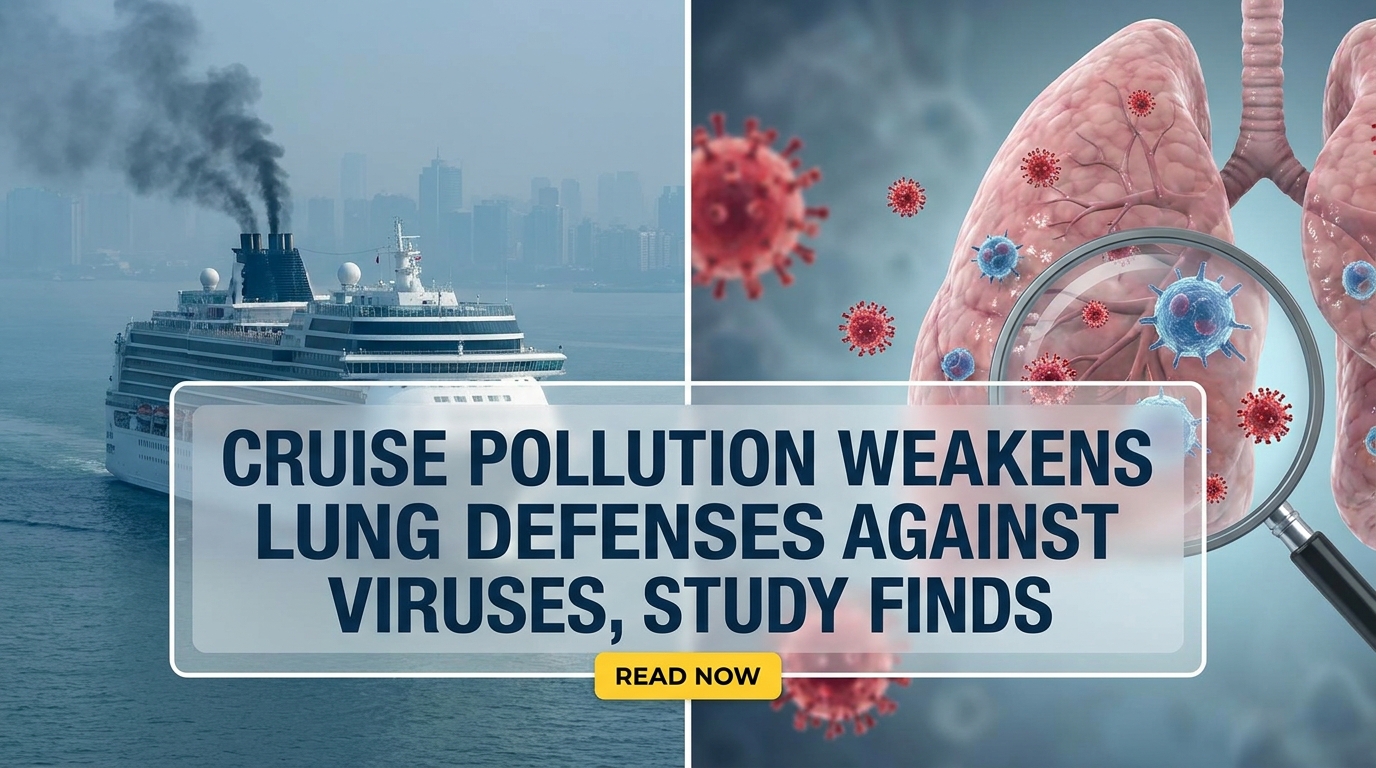


Cruise ship pollution may do more than irritate the airways. New laboratory research found that ultrafine particles associated with ship emissions increased inflammation in human lung cells and weakened their natural response to viruses.
The study does not prove that taking a cruise will cause a viral infection, nor does it show that every port resident faces the same level of exposure. It does, however, identify a plausible biological pathway through which pollution from ships burning fuel at berth could make respiratory infections harder for the lungs to control.
That distinction matters. The useful question is not, “Are cruises suddenly unsafe?” It is: Who is most exposed, what exactly did scientists observe, and which practical steps can reduce unnecessary contact with polluted port air?
What did the cruise ship pollution study find?
Researchers found that ultrafine particles collected near a busy cruise terminal triggered inflammation and reduced antiviral defenses in laboratory-grown lung cells.
The research team studied air pollution at five locations around the Port of Southampton in the United Kingdom. The sampling areas included:
- A busy cruise terminal
- A container terminal
- A dock entrance used by heavy goods vehicles
- Other locations within the port
- A comparison site about five kilometres away
Air samples were collected during the busier late spring and summer cruise period and during winter, when fewer cruise ships visited the port. Researchers found higher concentrations of vanadium, nickel and cobalt in fine and ultrafine particles at the cruise terminal during the busy season. Levels were also generally higher around the port than at the comparison site.
When wind arrived from the direction of cruise ships, and when more ships were present, concentrations of these pollution markers increased. This strengthened the evidence that docked vessels were an important source, although cargo traffic, road vehicles, fuel type and the amount of time ships remained at berth could also affect local pollution levels.
Can cruise ship pollution make viral infections worse?
The study found that exposed lung cells allowed cold and COVID-related viruses to produce more copies, but it did not directly measure illness in cruise passengers or port residents.
Researchers exposed human bronchial epithelial cells, which help line the airways, to ultrafine pollution particles collected during the active cruise season. They also separately examined the effects of vanadium, one of the elements strongly enriched in the samples.
The cells were then tested using:
- Human rhinovirus, a major cause of the common cold
- A laboratory model related to SARS-CoV-2, the virus responsible for COVID-19
After exposure to vanadium, both viruses replicated more effectively. The cells also showed stronger inflammatory signals and a weaker antiviral response.
In plain language, the pollution appeared to leave the cells irritated while making them less effective at slowing viral growth.
What the study proved and what it did not prove
| Research question | What the evidence shows |
|---|---|
| Did researchers find ship-related pollution around the port? | Yes. Pollution markers rose with cruise activity and winds from the ships. |
| Did the particles affect lung cells in the laboratory? | Yes. They increased inflammation and weakened antiviral responses. |
| Did viruses reproduce more after vanadium exposure? | Yes. Greater replication was observed in the cell experiments. |
| Did the study track actual cruise passengers? | No. It was not a passenger health study. |
| Did it prove that ship pollution causes COVID-19 or colds? | No. Viruses cause these infections. Pollution may affect the body’s ability to respond. |
| Does every cruise port have the same pollution level? | No. Exposure depends on ships, fuels, weather, port design and local controls. |
This is one of the most important points for readers. The research identifies susceptibility, not transmission. Cruise emissions cannot give someone a cold without exposure to the virus itself. The concern is that polluted air may make airway cells less capable of controlling an infection once exposure occurs.
What are ultrafine particles from cruise ships?
Ultrafine particles are extremely small pollution particles that can travel deeper into the respiratory system than larger forms of dust.
The University of Southampton described the particles examined in the study as no larger than roughly one-thousandth the width of a human hair. Their small size allows them to reach areas of the lungs that larger particles may not penetrate as easily. Some may potentially move beyond the lungs into the bloodstream.
Ultrafine particles can be produced when fuel is burned by:
- Ship engines
- Auxiliary generators
- Heavy trucks
- Industrial equipment
- Cars and buses
- Aircraft
At a cruise terminal, ships may continue running onboard systems while tied to the dock. This practice is often known as hoteling. Electricity is still required for lighting, kitchens, ventilation, refrigeration and passenger services, even when the vessel is not sailing.
From a traveler’s perspective, the pollution source may be almost invisible. A ship can appear stationary and quiet while its auxiliary machinery continues operating.
Why was vanadium important in the cruise pollution research?
Vanadium acted as a useful marker of fuel-related ship emissions and produced some of the clearest biological effects in the laboratory tests.
Vanadium occurs naturally and has several industrial uses, including strengthening steel. It can also be present in certain crude oils and petroleum residues, which is why elevated concentrations may help researchers identify pollution connected with fuel combustion.
In this study, vanadium was the most enriched element found in the relevant particle samples. Exposure caused inflammatory changes and helped the tested viruses reproduce inside airway cells.
This does not mean that vanadium is the only harmful part of cruise emissions. Exhaust is a mixture of particles, gases and trace elements. The study’s value lies in showing that both the collected pollution mixture and a prominent component within it produced concerning cellular effects.
Who faces the greatest exposure to cruise ship air pollution?
People who repeatedly spend time near active ports are likely to face greater cumulative exposure than a passenger briefly walking through a terminal.
Potentially exposed groups include:
- Port workers and ship crew members
They may spend repeated shifts near vessels, cargo operations and road traffic. - People living near cruise terminals
Residents may be exposed whenever ships berth, particularly when wind carries emissions toward nearby homes. - Taxi, coach and delivery drivers
Drivers often wait with doors or windows open near terminals and traffic queues. - Passengers with long embarkation delays
Queues on outdoor piers, balconies or roadways can increase the time spent near emissions. - People with existing respiratory conditions
Asthma, chronic obstructive pulmonary disease and other lung conditions may make polluted air more difficult to tolerate. - Older adults and young children
These groups may be more sensitive to respiratory irritants, although the new study did not separately test their risks.
For an occasional traveler, a few minutes outside a terminal is not equivalent to working there every day. The practical concern increases with proximity, pollution concentration, wind direction and time exposed.
Does cruise ship pollution affect passengers onboard?
Passengers may encounter ship emissions onboard, especially near exhaust outlets, upper outdoor decks and during time in port, but this particular study measured pollution around the port rather than individual exposure throughout a voyage.
That means the findings should not be stretched into a claim that every cabin, deck or ship has dangerous air.
Exposure can vary greatly depending on:
- The ship’s fuel and engine technology
- Whether exhaust-cleaning equipment is used
- The position of exhaust outlets
- Wind speed and direction
- Whether the ship connects to shore power
- The passenger’s location onboard
- The length of time spent near the terminal
- Nearby road and industrial pollution
A useful real-world clue is smell. A strong exhaust or fuel odor is not a scientific air-quality measurement, but it is a sensible reason to move indoors or to a different part of the ship.
Do not remain beside a smoky exhaust area simply to keep a preferred seat or photograph the port departure.
Can cruise ship pollution increase the risk of catching COVID-19?
Cruise pollution does not spread COVID-19, but the research suggests certain emissions may weaken cellular defenses after viral exposure.
COVID-19 mainly spreads when infectious respiratory particles pass between people. Crowded indoor areas, shared transport, close conversations and poor ventilation remain more direct infection concerns than the presence of a ship in port.
The new research adds another layer: airway cells exposed to vanadium showed increased viral replication in a COVID-related laboratory model.
For travelers, this means pollution precautions should complement, not replace, established infection precautions.
Pollution risk and infection risk are different
| Situation | Primary concern |
| Standing near visible ship exhaust | Air-pollution exposure |
| Waiting in a packed indoor terminal | Respiratory-virus transmission |
| Sharing a small vehicle with a coughing passenger | Close-contact infection |
| Living beside a busy cruise berth | Repeated pollution exposure |
| Touching shared buffet utensils | Hand contamination, depending on the virus |
| Spending time in a crowded, poorly ventilated lounge | Airborne infection risk |
A mask selected for particle filtration may reduce inhalation of some pollution particles and infectious aerosols when worn correctly. It cannot eliminate every exposure, and loose cloth face coverings provide less filtration than a well-fitted respirator.
How can cruise passengers reduce exposure at the port?
Passengers can reduce unnecessary exposure by limiting time near exhaust, avoiding road queues and moving away from active ship funnels.
Use these practical steps:
1. Complete check-in before reaching the terminal
Upload documents, confirm arrival times and prepare luggage tags before leaving the hotel. Less confusion at the curb means less time standing beside buses, taxis and idling vehicles.
2. Follow the assigned arrival window
Arriving several hours early can create unnecessary outdoor waiting. Terminals may not admit passengers before their scheduled time.
3. Avoid exercising near the port
A pre-cruise run beside an active berth increases breathing rate and the volume of air drawn into the lungs. Exercise farther inland or use an indoor facility with good filtration.
4. Move when you smell persistent exhaust
Do not wait beneath a funnel, beside an idling coach or next to a service road when another waiting area is available.
5. Keep vehicle windows closed in terminal traffic
Use recirculated air for short periods when surrounded by idling vehicles, then bring fresh air back into the cabin once traffic clears.
6. Carry necessary respiratory medication
People with asthma should keep their prescribed reliever accessible rather than placing it inside checked luggage.
7. Check local air quality
Government or recognized air-monitoring services may provide useful readings, although ultrafine particles are not routinely monitored in many places. The new research specifically highlights this monitoring gap.
What should port residents do when cruise pollution is heavy?
Residents do not need to remain indoors whenever a ship arrives, but they can reduce peak exposure during stagnant or downwind conditions.
A sensible home strategy includes:
- Close windows facing the port when exhaust odors are strong.
- Ventilate from the side of the building farthest from the berth.
- Avoid strenuous outdoor exercise beside the waterfront during busy arrivals.
- Use an appropriately sized HEPA air cleaner indoors.
- Replace heating and cooling filters on schedule.
- Keep children away from visibly smoky or heavily trafficked loading areas.
- Record repeated pollution episodes with dates, times, photographs and wind direction.
- Report persistent concerns to the local port authority or environmental regulator.
A portable air purifier works best when it is correctly sized for the room and allowed to run continuously. Placing a small unit in a large open-plan home will provide limited benefit.
Residents should also distinguish cruise emissions from nearby trucks, ferries, cargo equipment and road traffic. Ports contain several pollution sources, and meaningful regulation requires accurate monitoring rather than assumptions based only on ship size.
What symptoms can polluted port air cause?
Short-term exposure to polluted air can irritate the eyes, nose, throat and lungs, particularly in sensitive individuals.
Possible symptoms include:
- Burning or watery eyes
- Scratchy throat
- Coughing
- Chest tightness
- Wheezing
- Headache
- Shortness of breath
- An asthma flare-up
These symptoms are not specific to cruise emissions and can have many causes. A fuel smell alone also does not reveal the concentration or type of pollutant present.
Seek urgent medical help for:
- Severe difficulty breathing
- Blue or grey lips
- New confusion
- Chest pain
- Fainting
- Symptoms that rapidly worsen
- A prescribed rescue inhaler that is not providing expected relief
Someone with repeated symptoms near a port should note when they occur and discuss the pattern with a qualified healthcare professional.
What could ports and cruise lines do to reduce emissions?
Shore power is one of the clearest ways to cut emissions from docked ships because it allows vessels to switch off onboard engines and draw electricity from the local grid.
The researchers identified several approaches that may help protect communities:
- Shore-side electrical connections
- Cleaner or carefully assessed alternative fuels
- Improved exhaust-control technology
- Greater monitoring of ultrafine particles
- Better data on public-health effects
- Stronger protection for neighborhoods near terminals
Shore power is not automatically emission-free. Its total benefit depends partly on how the electricity is generated. However, it can move combustion away from densely populated waterfronts and reduce local exhaust while ships are docked.
Port authorities can also reduce exposure through:
- Anti-idling rules for coaches and trucks
- Cleaner cargo-handling equipment
- Real-time air monitoring
- Transparent publication of pollution data
- Berth assignments based on wind and neighborhood proximity
- Faster passenger-processing systems
- Vegetation and infrastructure designed around local air flow
The strongest policy response addresses the entire port, not only cruise ships.
Are ultrafine particles regulated?
Ultrafine particles remain poorly monitored and are not regulated as consistently as larger particle categories.
Air-quality rules often focus on PM2.5 and PM10, which describe particles below specific size thresholds. Ultrafine particles are smaller still and are commonly measured by particle number rather than mass.
A large number of extremely tiny particles may contribute little to the total measured mass. As a result, standard readings can miss part of the pollution picture highlighted by the Southampton research.
The study authors argue that ultrafine-particle monitoring is needed to guide regulation and better understand risks in port communities.
Should people cancel a cruise because of this study?
The study alone is not a reason for most healthy travelers to cancel a cruise. It is a reason to take port air pollution seriously and avoid preventable exposure.
The research was conducted around one major UK port and used laboratory cell models. It did not measure the rate of respiratory infections among passengers, compare individual cruise lines or establish a safe exposure limit.
Travelers should consider their own circumstances.
| Traveler | Sensible response |
| Healthy adult taking an occasional cruise | Avoid exhaust hotspots and follow normal respiratory precautions |
| Person with controlled asthma | Carry medication, limit exposure and discuss concerns with a clinician |
| Person with severe heart or lung disease | Seek individual medical advice before travel |
| Family with a young child | Avoid long roadside waits and smoky outdoor areas |
| Frequent cruiser or ship employee | Pay closer attention to repeated occupational exposure |
| Port resident | Monitor local conditions and support transparent emissions reporting |
The correct response is neither panic nor dismissal. Laboratory findings cannot tell one traveler exactly how much risk they face, but they can reveal a problem worth reducing before stronger population-level evidence arrives.
The most useful takeaway for cruise travelers and port cities
Cruise ship emissions may create a double burden by inflaming the airways while weakening the cells that help control respiratory viruses.
The new study makes its strongest case at the biological level. It found a recognizable pollution signature near active cruise berths, identified ultrafine particles enriched with fuel-related metals and showed that exposure changed how lung cells responded to viral infection.
It does not show that one afternoon at a cruise port will make someone ill. It does show why clean shore power, better air monitoring and simple personal precautions are more than environmental talking points.
For travelers, the practical rule is easy to remember: spend less time beside exhaust, more time in clean and well-ventilated spaces, and never ignore respiratory symptoms because you are on holiday.
Frequently asked questions about cruise ship pollution and lung health
Does cruise ship pollution weaken the immune system?
The research found a weaker antiviral response in laboratory-grown airway cells, not a complete weakening of the human immune system. More human research is needed to measure the real-world effect.
Can cruise ship fumes cause a cold?
No. A virus causes the common cold. Ship pollution may make airway cells more susceptible after viral exposure, according to the laboratory findings.
Is air pollution worse when cruise ships are docked?
Pollution can increase while ships remain at berth and continue running engines or generators. In the Southampton study, relevant pollution markers rose during the busy cruise season and when winds came from the direction of the ships.
Are cruise passengers or port residents at greater risk?
Repeated exposure is generally more concerning than brief exposure, making workers and nearby residents an important group for further study. Personal risk still depends on health, distance, weather and pollution controls.
What is shore power for cruise ships?
Shore power allows a docked ship to connect to the land-based electrical grid and turn off engines otherwise used to supply onboard electricity.
Do cabin air filters remove cruise pollution?
Filter performance varies by ship and ventilation system. Travelers should not assume every cabin filter removes ultrafine particles, particularly when balcony doors are open near exhaust.
Should people with asthma avoid cruises?
Not automatically. People with asthma should keep medication accessible, avoid strong exhaust and seek personalized advice when their condition is severe or poorly controlled.