
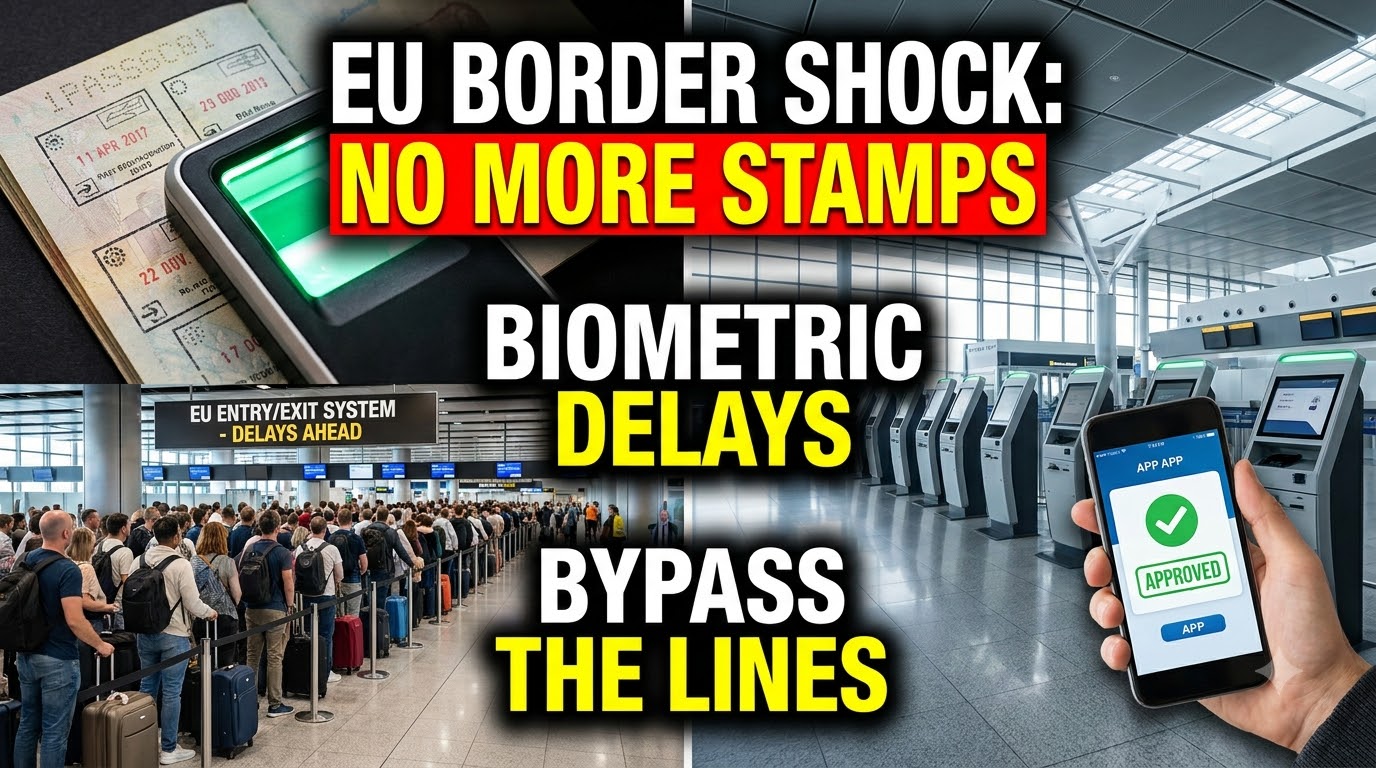


The European Union has officially replaced manual passport stamping with the Entry/Exit System (EES), a mandatory digital biometric tracking network for all non-EU short-stay travelers. While this system effectively prevents immigration overstays and identity fraud, initial rollouts at major Schengen borders have triggered massive bottlenecks, with some travelers facing up to five-hour wait times. Avoiding these exhaustive lines requires strict preparation, a biometric passport, and the immediate utilization of new self-service kiosks or mobile pre-registration applications.

What is the EU Entry/Exit System (EES)?
The Entry/Exit System is an automated IT border control mechanism that electronically registers non-EU nationals each time they cross an external Schengen border. Instead of relying on easily forged ink stamps, border officials now collect highly secure biometric data. This massive infrastructure upgrade ensures accurate tracking of exactly how long a visitor remains inside the territory.
The system records the following specific information during the initial registration:
- Passport number, expiration date, and issuing country.
- Full legal name and date of birth.
- Four fingerprints (excluding thumbs).
- A high-resolution facial scan.
- The exact date and physical location of every entry and exit.
Children under the age of 12 are entirely exempt from the fingerprinting requirement. Authorities will only capture a facial image for these younger travelers to complete their registration.
Who Exactly is Affected by the New Border Rules?
The European Commission applies the EES to all “third-country nationals” traveling to the Schengen Area for a short stay. A short stay is legally defined as a maximum of 90 days within a rolling 180-day period. This specific rule includes travelers who require a short-stay visa and those who enjoy visa-free privileges, such as citizens of the United States, Canada, the United Kingdom, and Australia.
The system does strictly exempt several specific groups:
- Citizens of EU member states, Switzerland, Norway, Iceland, and Liechtenstein.
- Foreign nationals holding an official residence permit or long-stay visa for a Schengen country.
- Beneficiaries of the Brexit Withdrawal Agreement residing in an EU host state.
It is critical to note that the EES is active at all external Schengen borders, but Cyprus and Ireland do not currently participate in the biometric network. Passports are still manually stamped by agents in those specific nations.
Why Are Travelers Facing Severe Delays?
The sudden shift from a three-second manual passport stamp to a complex biometric enrollment process has severely strained major border crossing points. The initial registration requires travelers to physically scan their passports, provide facial images, and press their fingers onto digital scanners. If a machine malfunctions or a traveler fails to follow scanner instructions, the entire line halts.
Airports Council International Europe reported severe technical disruptions during the 2026 rollout. Massive chokepoints developed rapidly at high-volume hubs like Paris-Charles de Gaulle and land borders like the Port of Dover. Processing a family of four can now take up to ten minutes at the desk. This delay compounds rapidly into multi-hour waits during peak summer holiday and holiday transit windows.
Step-by-Step Fixes: How to Avoid Border Bottlenecks
Travelers can aggressively cut their wait times by exploiting the automated technology designed to bypass the main manual border guard desks.
- Use the “Travel to Europe” App: Several member states now support this official mobile application. Download it prior to departure to input passport details and answer mandatory border questions while sitting on the airplane or train.
- Locate the Self-Service Kiosks Immediately: Upon arrival at major international airports, bypass the static lines and look for EES self-service terminals. Travelers scan their own biometric passports, capture their facial images, and register their fingerprints independently.
- Prepare Travel Documents Properly: Remove passports from decorative covers or bulky wallets. Have boarding passes and hotel reservation proofs physically printed. Attempting to load digital documents on a slow airport cellular network stalls the entire queue.
- Leverage the Three-Year Rule: The system retains biometric files for three years. If a traveler completes the initial registration, subsequent trips require only a quick facial scan at the automated eGates, completely bypassing the manual fingerprinting desk.
Specific Bottlenecks at UK-EU Border Crossings
Travelers crossing from the United Kingdom into France face highly unique geographic challenges due to juxtaposed border controls. At specific locations like the Port of Dover, the Eurotunnel terminal in Folkestone, and St Pancras International station in London, French border police conduct EES checks before passengers even depart UK soil.
The physical constraints of these specific transit terminals mean there is very little room to install dozens of automated self-service kiosks. Travelers using these land and rail routes must arrive at least three to four hours before their scheduled departure time during peak holiday weekends. Arriving early is the only proven method to ensure clearance through the biometric enrollment lines before the train or ferry departs.
EES vs. ETIAS: Understanding the Difference
Many travelers confuse the Entry/Exit System with the upcoming European Travel Information and Authorisation System (ETIAS). While both fall under the broader EU Smart Borders initiative, they serve completely different operational functions.
- EES (Entry/Exit System): A physical border tracking system that collects biometrics upon arrival and departure to track the exact length of stay.
- ETIAS: An electronic travel authorization that visa-exempt nationals must secure online before boarding a flight or crossing a border. ETIAS functions as a pre-travel clearance check, while EES functions as an on-the-ground verification process.
How Does the System Enforce the 90-Day Rule?
The digital tracking software eliminates any guesswork regarding legal stay limits. The EES database automatically calculates exactly how many days a traveler has remaining in the Schengen Area. The system flags unauthorized entries instantly and alerts authorities if an individual overstays their permitted 90-day window. Travelers can also consult the public EES web portal to verify their own remaining travel days, completely removing the risk of accidental immigration violations.