
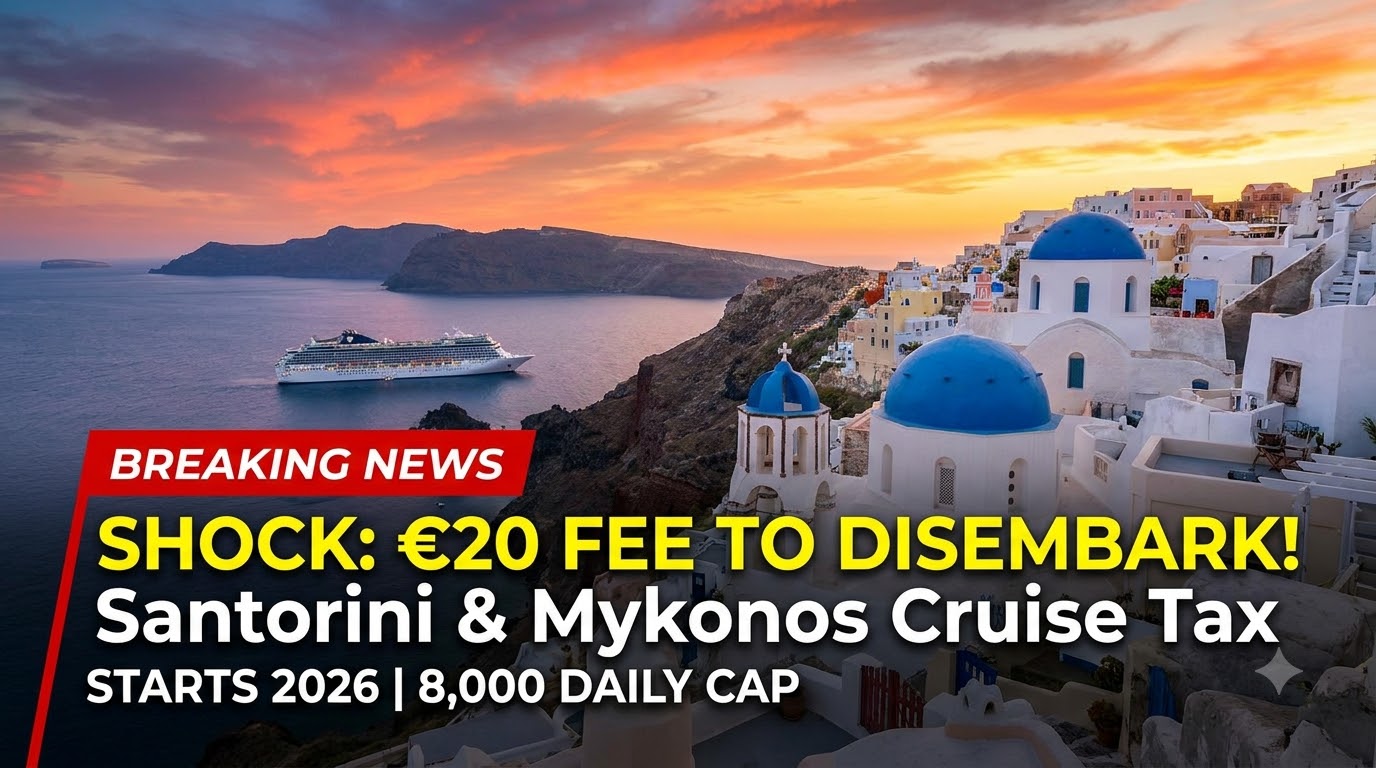


Cruise passengers getting off a ship in Santorini or Mykonos during Greece’s peak season now face a mandatory €20 charge per person, per port. The levy has been in force, and the same seasonal rate structure continues to affect cruises. Santorini is also operating with a separate 8,000-cruise-passenger daily ceiling, limiting how many visitors cruise lines can schedule onto the island on a given day.
For travelers, the most important detail is simple: the €20 fee applies when you actually disembark at Santorini or Mykonos between June 1 and September 30. It is not a flat fee added once for your entire Greek cruise, and the Santorini passenger limit is not the same policy as the tax.
How much is Greece’s cruise passenger fee?
Santorini and Mykonos carry Greece’s highest cruise charge because they face the greatest pressure from concentrated visitor arrivals. The official framework sets lower charges outside summer and significantly lower rates at other Greek ports. The Greek Ministry of Tourism announced the seasonal structure as part of measures intended to better manage heavily visited destinations.
| Travel period | Santorini & Mykonos | Other Greek ports |
|---|---|---|
| June 1–September 30 | €20 per passenger, per port | €5 |
| April 1–May 31 | €12 | €3 |
| October 1–31 | €12 | €3 |
| November 1–March 31 | €4 | €1 |
The amounts are established in the Greek cruise-fee rules published under the relevant ministerial decision.
Query: Is the €20 Santorini cruise fee charged once per cruise?
No. The fee is charged per passenger and per Greek port where the passenger disembarks.
That distinction can materially change your onboard spending total.
Consider two travelers on a peak-summer itinerary that includes:
- Santorini: €20 each
- Mykonos: €20 each
- Another Greek port: €5 each
The government levy associated with those three shore visits would therefore be €45 per person, or €90 for two travelers.
That is why travelers comparing cruise fares should not look at the €20 headline in isolation.
Do you pay the Greece cruise tax if you stay on the ship?
The underlying levy applies to passengers who disembark, so remaining onboard avoids the charge for that port. The government rules place responsibility for collecting and remitting the money on cruise companies, shipping agents or the relevant Greek management company rather than asking individual passengers to find a government payment counter.
How the charge appears to you can vary by cruise operator.
For example, MSC Cruises says it adds the applicable fee to a guest’s onboard account after a Greek-port visit and does not charge passengers who remain onboard.
That creates a useful practical rule:
Do not assume the levy was included in your advertised cruise fare. Check your cruise line’s Greece fee policy before sailing and look at your onboard account after each Greek call.
If your statement looks wrong, raise it with guest services while still onboard rather than waiting until after the cruise, when reconstructing who went ashore can become more difficult.
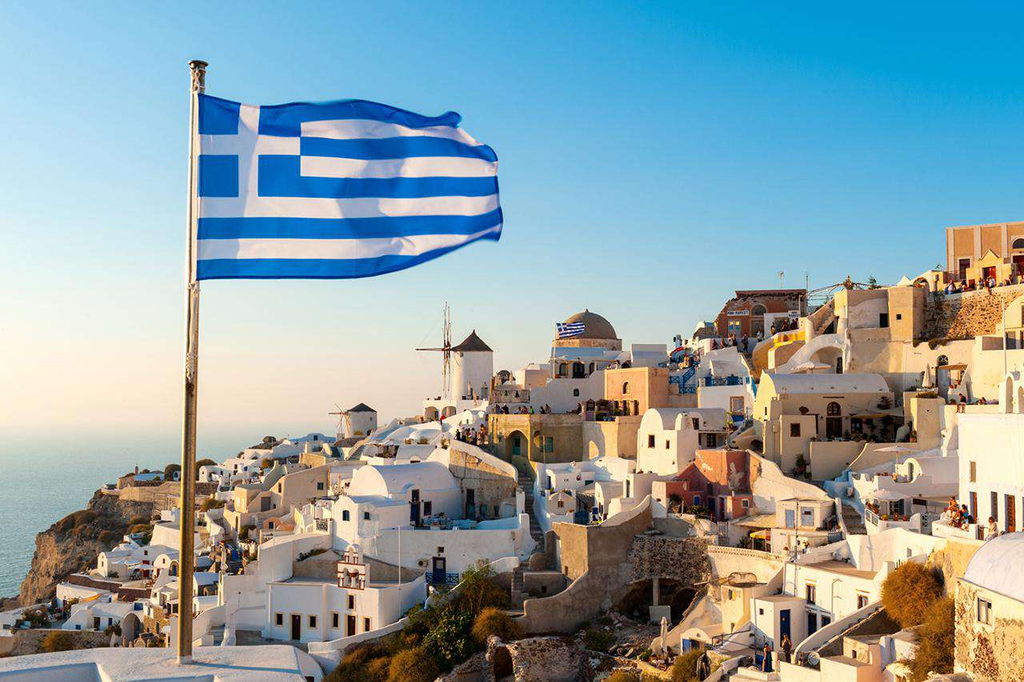
Santorini’s 8,000-passenger cruise cap is separate from the €20 fee
Santorini allows no more than 8,000 cruise passengers or visitors to be scheduled on the island on the same day under its 2025–2026 berth-allocation policy. This is a local traffic-management measure and should not be confused with the nationwide cruise levy.
The difference matters:
- €20 levy: a monetary charge affecting passengers who disembark.
- 8,000-passenger ceiling: a scheduling constraint affecting cruise calls to Santorini.
- Mykonos: subject to the €20 peak-season levy, but the cited Santorini 8,000-person berth ceiling should not be presented as a matching Mykonos rule.
That last point is important because many quick summaries combine “Santorini and Mykonos” throughout the story and can leave travelers thinking both islands have exactly the same passenger restrictions.
They do not.
What does Santorini’s 8,000-passenger limit actually mean?
Cruise lines cannot simply keep adding ships to a busy Santorini day once the berth-allocation system reaches its limit. The Municipal Port Fund of Thira ranks and processes cruise-call requests and can leave requests unconfirmed when capacity limits are exceeded. Alternative dates may then be proposed.
There is also an important 2026 change that travelers are unlikely to notice when merely looking at the headline number.
For 2025 scheduling, Santorini estimated each ship at 80% of passenger capacity. For 2026, ships are counted at 100% of capacity.
That makes the same nominal 8,000 ceiling more restrictive.
A ship capable of carrying 4,000 passengers could have counted as roughly 3,200 passengers under the 2025 scheduling assumption. Under the 2026 policy, its full 4,000 capacity counts toward the daily ceiling.
For cruisers, this can mean:
- fewer large ships accommodated on the same date;
- itinerary dates becoming more important;
- cruise lines adjusting port-call schedules;
- less extreme crowd concentration than on historically overloaded days.
Will the €20 Santorini fee make the island noticeably quieter?
The fee alone does not guarantee a quiet Santorini visit; the daily cruise limit is likely to have a more direct effect on crowd volume.
There is a fundamental difference between pricing and capacity.
A traveler who has already spent several thousand euros on a Mediterranean cruise may still happily pay another €20 for Santorini. A capacity ceiling, by contrast, can prevent additional cruise passengers from being scheduled onto that day in the first place.
This is why travelers should pay more attention to how many ships are calling Santorini on their date than simply assuming the €20 charge will eliminate crowds.
A day with 7,500 scheduled cruise visitors can still feel extremely busy around the Old Port, Fira and Oia because visitors funnel through a limited number of transport routes and famous viewpoints.
What cruise passengers should do before visiting Santorini
Check your ship’s arrival pattern before deciding how to spend your limited hours ashore.
The classic mistake is to leave the ship, follow the largest flow of passengers toward the same attractions, and then discover that a significant part of a six-hour call has been spent waiting rather than sightseeing.
A smarter Santorini day usually follows these principles:
- Check your actual port time, not just the itinerary headline. Tender operations can reduce usable shore time.
- Treat the last return-to-ship time as fixed. Do not plan your day around the ship’s departure time.
- Avoid building an itinerary with too many transfers. Santorini is geographically small, but congestion can make short distances slow.
- Keep proof of cruise-line excursions or independent reservations accessible offline. Mobile coverage can become strained in busy areas.
- Check your onboard account after the visit. The cruise levy should correspond with whether you disembarked and the applicable seasonal rate.
- Budget the levy separately from shore-excursion prices. A €150 excursion does not automatically mean Greece’s government fee is included.
Is October cheaper for cruise passengers visiting Santorini or Mykonos?
Yes. The government levy falls from €20 to €12 per person at Santorini and Mykonos during October. It is also €12 during April and May. From November through March, the charge falls to €4.
For a couple, visiting both Santorini and Mykonos produces this comparison:
| Season | Santorini + Mykonos fee per person | Total for two travelers |
|---|---|---|
| June–September | €40 | €80 |
| April, May or October | €24 | €48 |
| November–March | €8 | €16 |
That difference is not large enough by itself to justify completely changing a vacation, but it becomes one more reason to examine shoulder-season Mediterranean cruises.
The bigger potential benefits are often lower heat, different crowd levels and more comfortable walking conditions, although weather and available cruise schedules also become less predictable outside the core summer period.
Why did Greece introduce the cruise passenger levy?
Greek authorities designed the system to put a higher cost on heavily visited destinations while generating money linked to tourism and infrastructure needs.
Santorini and Mykonos receive a special rate precisely because visitor pressure can become concentrated in relatively small areas. Other Greek ports pay only a quarter of their peak-season rate: €5 instead of €20 between June and September.
The wider Greek cruise market has continued growing despite the charge. Final 2025 data from the Bank of Greece showed cruise-passenger receipts rising 4.9% year over year, while total cruise-passenger visits rose 4.5% to about 8.18 million across Greece.
That is useful context because it shows why describing the levy simply as a measure intended to “stop cruising” misses the point. Greece continues to receive substantial cruise traffic while trying to manage where and when some of that traffic arrives.
Query: Does every passenger have to personally pay €20 at Santorini?
No payment booth or individual government transaction should be required from the average cruise passenger. Greek rules make the cruise company, shipping agent or relevant management company responsible for remitting the charge.
Your cruise line may therefore:
- post the amount to your onboard account;
- collect it as part of your end-of-cruise bill;
- show it under taxes, local fees or government charges.
The operational method can differ between lines, so check the wording provided for your exact sailing.
The detail travelers should remember
The easiest way to understand Greece’s cruise rules is to separate “going ashore” from “how many people can arrive.”
If you disembark in Santorini or Mykonos between June 1 and September 30, the government levy is €20 per passenger, per port.
If you remain onboard, the disembarkation-based levy should not apply for that port.
And if Santorini is on your itinerary, its separate 8,000-passenger daily berth-allocation ceiling affects how cruise ships are scheduled before you even arrive.
For travelers, that means the best preparation is not complicated: check your sailing date, count your Greek port calls, budget the fees separately, and review the ship schedule around your Santorini day. Those four details tell you considerably more about the real impact on your trip than the €20 headline alone.