
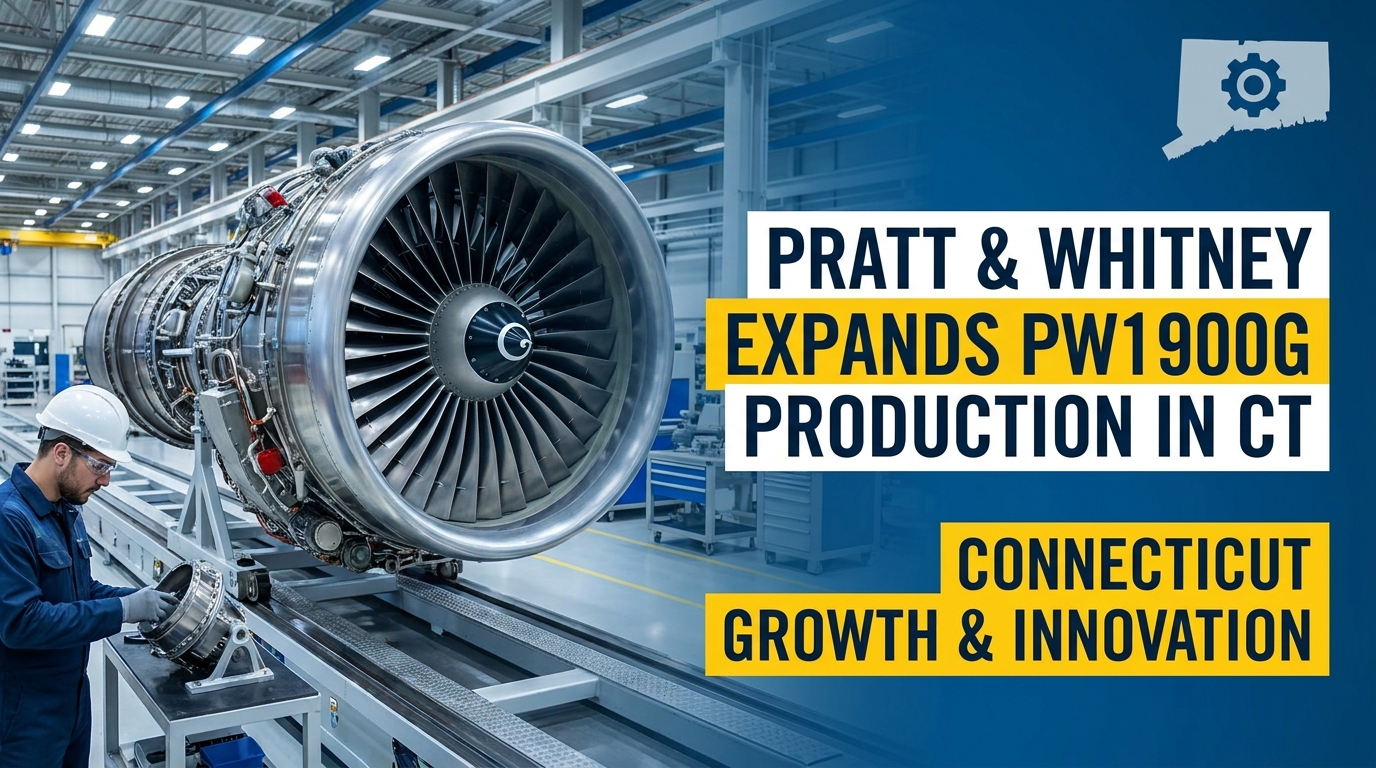


Pratt & Whitney has completed its first production PW1900G engine at its Middletown Engine Center in Connecticut, adding another manufacturing source for the engines used exclusively by Embraer’s E190-E2 and E195-E2 passenger jets.

The milestone gives Pratt & Whitney more capacity and flexibility as Embraer increases E2 deliveries and airlines seek more efficient aircraft for short and medium-distance routes. It also carries wider significance for the engine manufacturer, which has been working to improve GTF production, parts availability, maintenance capacity, and engine durability.
For passengers, the change will not be visible inside an aircraft cabin. For airlines and manufacturers, however, another working production line can mean more predictable engine deliveries, fewer incomplete aircraft waiting for powerplants, and greater protection against disruption at a single facility.
What Did Pratt & Whitney Achieve in Middletown?
The company produced its first customer-bound PW1900G at the Middletown Engine Center, expanding a Connecticut facility already experienced in assembling other Pratt & Whitney engines.
Middletown has a long history of commercial and military engine work. Pratt & Whitney previously introduced a horizontal moving assembly line there for the PW1100G-JM, the GTF engine offered on Airbus A320neo-family aircraft. Adding PW1900G production broadens the plant’s commercial workload and gives the Embraer E2 program additional manufacturing support.
The practical importance is straightforward:
- More assembly capacity for the Embraer E2 engine program
- Reduced dependence on one production flow
- Greater flexibility when demand or delivery schedules change
- More room to recover from supplier or labor disruptions
- Closer use of established Connecticut skills and tooling
This is not the first PW1900G associated with Middletown. A development engine assembled there completed its first flight aboard Pratt & Whitney’s test aircraft in November 2015. The new milestone concerns the expansion of regular production work rather than the engine’s original development program.
Also read – 8 Car-Free U.S. Islands Where Traffic Disappears
What Is the PW1900G Engine?
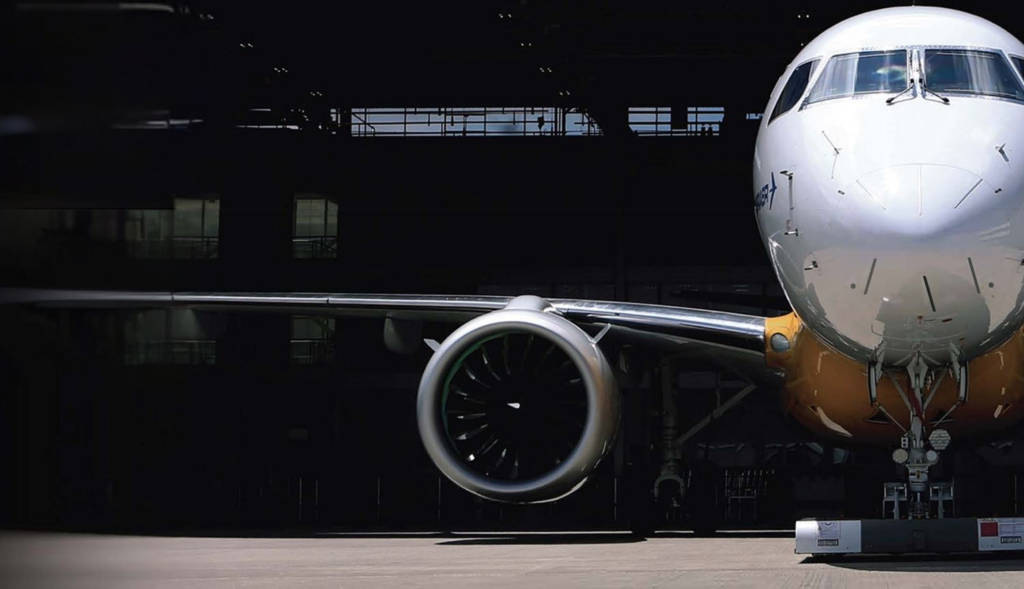
The PW1900G is the exclusive engine for Embraer’s current E190-E2 and E195-E2 aircraft.
It belongs to Pratt & Whitney’s geared turbofan, or GTF, family. A reduction gearbox allows the large front fan to turn at a slower speed while internal compressor and turbine sections rotate faster. Each part can therefore operate closer to its most efficient speed instead of being forced to rotate together at one rate.
In simple terms, the geared system is designed to help an aircraft use less fuel and create less noise.
Pratt & Whitney says the PW1900G-powered E2 family can deliver:
| Performance area | Claimed improvement |
|---|---|
| Fuel consumption per seat | Up to 25% lower |
| Noise footprint | Up to 75% smaller |
| Nitrogen oxide emissions | Up to 50% lower |
| Approved synthetic aviation fuel blend | Up to 50% SAF |
These comparisons are made against earlier-generation aircraft and depend on the operating mission, aircraft model, seating arrangement, and regulatory measurement used. The engine has also been tested with 100% sustainable aviation fuel, although widespread commercial use depends on future fuel approval and availability.
Which Aircraft Use the PW1900G?
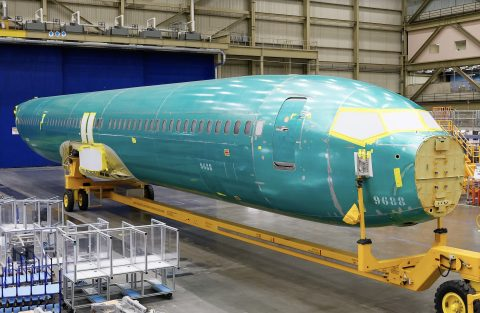
The PW1900G powers Embraer’s E190-E2 and E195-E2, two single-aisle jets designed for routes that do not require a larger Airbus A320 or Boeing 737.
| Aircraft | Typical role | Why airlines choose it |
| Embraer E190-E2 | Lower-demand regional and medium-range routes | Capacity control, range and lower trip costs |
| Embraer E195-E2 | Busier regional routes and thinner mainline markets | More seats without moving to a larger narrowbody |
These aircraft allow an airline to match capacity more closely with actual passenger demand. A carrier can operate additional frequencies or serve a smaller city without filling, and paying to operate, a much larger jet.
Embraer says the E190-E2 and E195-E2 provide significant fuel-efficiency improvements per seat over the first-generation E-Jets. The exact saving differs between the two aircraft and depends on an airline’s configuration and operation.
Why Does a Second PW1900G Production Source Matter?
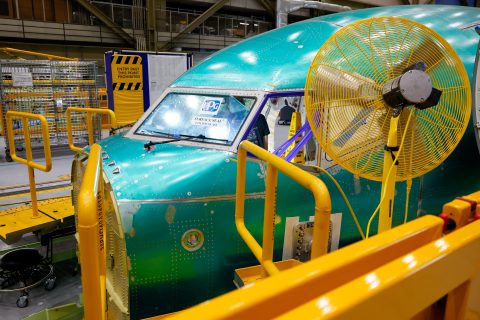
A second production source matters because aircraft manufacturers cannot deliver a finished jet without engines, even when the fuselage, wings, cabin, and avionics are ready.
Engine shortages have become a major constraint across commercial aviation. An aircraft waiting on engines ties up factory space, delays airline fleet plans, and can force a carrier to retain an older aircraft longer than intended.
Adding Middletown capacity helps address four risks.
1. Production Bottlenecks Can Delay Entire Aircraft
An engine bottleneck quickly becomes an aircraft-delivery bottleneck. Each E190-E2 or E195-E2 requires two PW1900G engines, plus airlines and maintenance networks need spare units to protect daily operations.
A factory does not solve this problem simply by assembling engines faster. It must receive hundreds of correctly certified parts, complete inspections, run tests, document the engine configuration, and deliver it according to Embraer’s final assembly schedule.
2. One Facility Should Not Carry All the Risk
Multiple capable production locations provide resilience when one site faces material shortages, maintenance downtime, weather disruption, or labor problems.
Pratt & Whitney’s Connecticut operations experienced disruption during a three-week machinists’ strike in May 2025. Expanding production does not remove labor or supply-chain risk, but distributing capability can give managers more options when one part of the network falls behind.
3. Embraer Needs Engines to Support E2 Growth
Embraer’s sales opportunities depend on reliable PW1900G availability because the E2 family has no alternative engine supplier.
Unlike some aircraft programs where airlines can choose between two competing engines, the E190-E2 and E195-E2 are tied to the PW1900G. That makes the relationship between Embraer and Pratt & Whitney particularly important.
Pratt & Whitney said in April 2026 that it expected full engine availability for Embraer’s E2 fleet by the end of the year. Embraer also recognized the manufacturer for its production and aftermarket collaboration.
4. Airlines Need Both New Engines and Spare Capacity
Delivering engines for new aircraft is only part of the job. Airlines also need spare engines and repair capacity to keep existing jets flying.
When an engine is removed for inspection or maintenance, the airline can install a spare and return the aircraft to service. Without that spare, the aircraft may remain parked until the original engine comes back from the shop.
That is why production expansion and maintenance expansion must happen together.
Is This Connected to Pratt & Whitney’s GTF Engine Problems?
The production expansion forms part of Pratt & Whitney’s wider effort to stabilize the GTF program, but the PW1900G has not faced disruption on the same scale as the PW1100G-powered Airbus A320neo fleet.
The broader GTF family has dealt with durability problems, maintenance congestion, limited spare-engine availability, and accelerated inspections linked to contaminated powder metal used in certain engine components.
Embraer has said its aircraft were less affected than some other GTF-powered fleets, although the E2 program was not completely isolated from engine-related pressures.
The distinction matters. Readers should not assume that every GTF model, production batch, and aircraft application has experienced identical problems.
| GTF variant | Main aircraft application |
| PW1100G-JM | Airbus A320neo family |
| PW1500G | Airbus A220 family |
| PW1900G | Embraer E190-E2 and E195-E2 |
These engines share the geared architecture, but they differ in size, configuration, parts, operating environment, and fleet history.
What Is Pratt & Whitney Doing to Improve GTF Durability?
Pratt & Whitney is introducing updated hot-section technology intended to extend the time an engine can remain in service before major maintenance.
The hot section contains components exposed to the engine’s highest temperatures and pressures. Durability in this area has a direct effect on maintenance intervals and airline reliability.
Pratt & Whitney’s Hot Section Plus package is scheduled to begin entering service in 2026. The company says it uses around 35 revised part numbers and can be installed during maintenance visits. It is designed to be interchangeable with existing GTF configurations, which should make fleet planning less complicated for airlines.
The company has said these technologies are also being incorporated into the PW1900G program to improve durability and time on wing.
Why Production Numbers Alone Do Not Tell the Whole Story
A completed engine is useful only when it passes testing, reaches the aircraft factory on schedule, and is supported throughout its working life.
Aviation readers should watch more than headline production totals. The stronger indicators include:
- How many engines reach Embraer on time
- Whether spare-engine availability improves
- How long engines remain on wing
- How quickly maintenance shops complete overhauls
- Whether parked E2 aircraft return to service
- Whether Embraer can increase deliveries without engine delays
A new production line creates potential capacity. Consistent delivery performance proves whether that capacity is working.
How Is the PW1900G Maintenance Network Expanding?
Pratt & Whitney is adding global overhaul capacity because building more new engines will not clear maintenance queues on its own.
The company’s GTF maintenance network had grown to 21 engine centers and about 40 component-repair facilities by April 2026. Pratt & Whitney said more than 2,700 GTF-powered aircraft had been delivered to over 90 customers, supported by approximately 13,000 engine orders and commitments across the family.
Important PW1900G maintenance developments include:
- OGMA in Portugal, which is adding PW1900G overhaul capability
- ITP Aero in Spain, joining the network with maintenance and test capability
- Additional component-repair investments to reduce parts turnaround time
- U.S. maintenance expansion aimed at increasing overall GTF shop capacity
OGMA’s facility is expected to service both Pratt & Whitney engines used by Airbus aircraft and PW1900Gs used by Embraer’s E2 family. At full output, the site is expected to handle up to 240 engines annually across its approved work.
What Does the Middletown Milestone Mean for Embraer?
The milestone gives Embraer a stronger engine supply base at a time when the aircraft manufacturer is pursuing larger E2 campaigns and higher production.
Recent airline commitments show why that matters. SAS announced an order for 55 E195-E2 aircraft, with options and purchase rights that could expand the agreement further. The aircraft are powered by PW1900G engines.
Virgin Australia has also selected E190-E2 aircraft for regional operations in Western Australia. Embraer says the aircraft offers a flying range of around six hours and substantially lower emissions than the Fokker 100s it is replacing.
Each new E2 order creates demand for:
- Two installed engines per aircraft
- Spare engines
- Replacement parts
- Maintenance slots
- Trained technicians
- Long-term technical support
The sale is therefore not complete when an airline signs an aircraft contract. The engine network must support the fleet for decades.
Will Passengers Notice Any Difference?
Passengers will not notice where the engine was assembled, but they may benefit indirectly if stronger production reduces aircraft delays and improves fleet reliability.
On board an E2, the more obvious passenger features include:
- A two-by-two seating layout with no middle seat
- Large overhead storage on many configurations
- Lower cabin noise than older regional jets
- A wider-feeling cabin than many traditional regional aircraft
- Access to longer routes than smaller regional jets usually operate
The production change itself does not alter cabin comfort or engine performance. A Middletown-built PW1900G must meet the same approved configuration, manufacturing standards, inspections, and performance requirements as an engine assembled elsewhere.
What Should Airlines Watch Next?
Airlines should watch delivery reliability, spare-engine supply, updated component performance, and maintenance turnaround times rather than celebrating one engine in isolation.
The most useful questions for the remainder of 2026 are:
- How quickly will Middletown increase PW1900G output?
- Will the added line improve delivery timing for Embraer?
- When will full engine availability be reached?
- Will updated hot-section parts deliver longer time on wing?
- Can MRO growth reduce the number of engines waiting for repair?
- Will PW1900G availability support Embraer’s planned E2 ramp-up?
These are the measures that determine whether the milestone becomes a lasting production improvement.
What the PW1900G Expansion Means in One Table
| Question | Direct answer |
| What happened? | Pratt & Whitney completed its first production PW1900G at Middletown |
| Where is Middletown? | Connecticut, United States |
| Which aircraft use the engine? | Embraer E190-E2 and E195-E2 |
| Why does it matter? | It adds production capacity and supply resilience |
| Will passengers notice? | Not directly |
| Does it solve every GTF issue? | No, maintenance and durability work must continue |
| What should be watched next? | Deliveries, spare engines, time on wing and repair turnaround |
Final Verdict: This Is More Than a Factory Milestone
Pratt & Whitney’s first production PW1900G from Middletown matters because engine availability now influences how quickly Embraer can build aircraft and how reliably airlines can operate them.
One completed engine will not solve the GTF program’s production and maintenance pressures. It does, however, show that Pratt & Whitney is adding another practical source of PW1900G output while expanding repair capacity and introducing more durable components.
The next test is consistency. If Middletown can move from a first engine to dependable repeat production, the result could support faster E2 deliveries, more spare engines, and a healthier operating fleet.
That is the real story behind the factory milestone.