
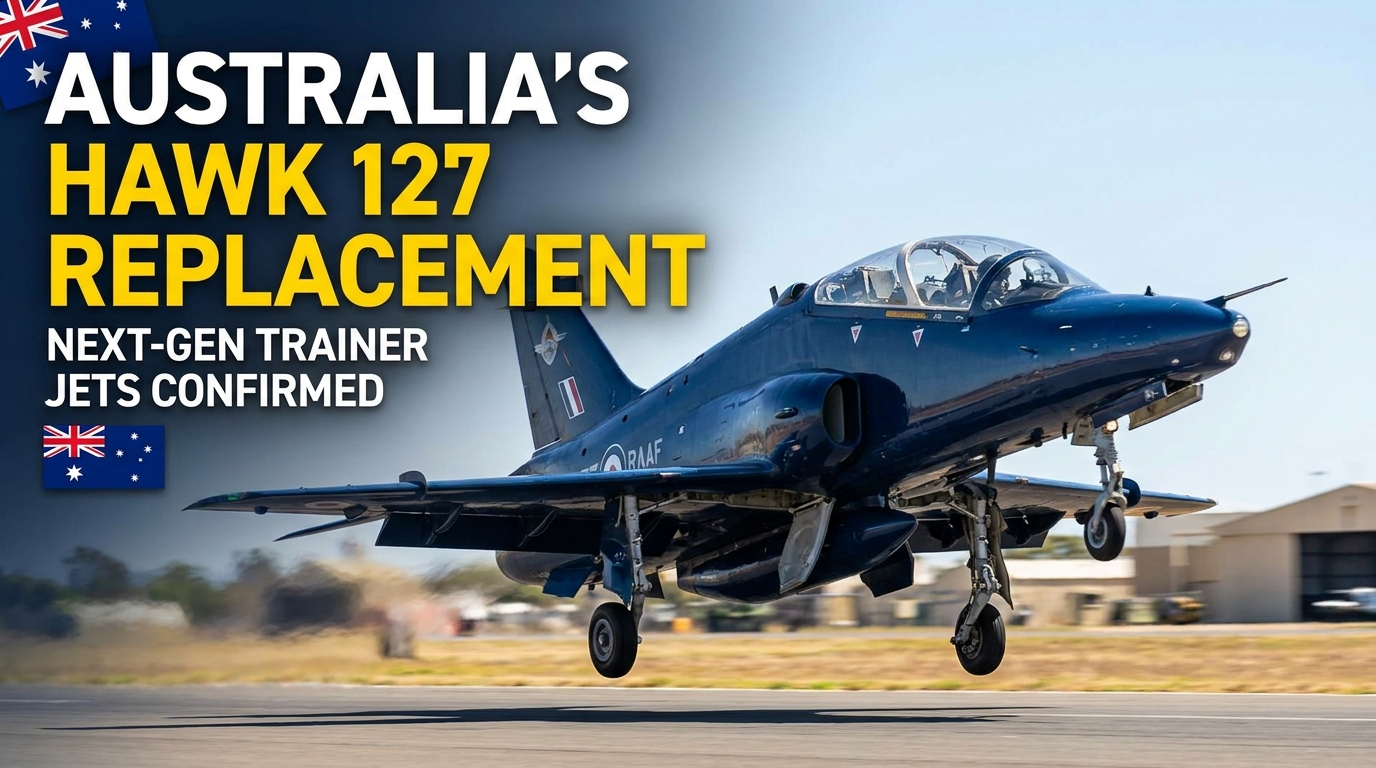


Australia is advancing plans to replace the Royal Australian Air Force’s ageing Hawk 127 fleet as it prepares pilots for a more demanding generation of combat aircraft. The future program is expected to cover far more than buying a new jet. It must provide simulators, courseware, instructors, maintenance support, mission-training software, and a clear path from the Pilatus PC-21 into aircraft such as the F-35A Lightning II, F/A-18F Super Hornet, and EA-18G Growler.
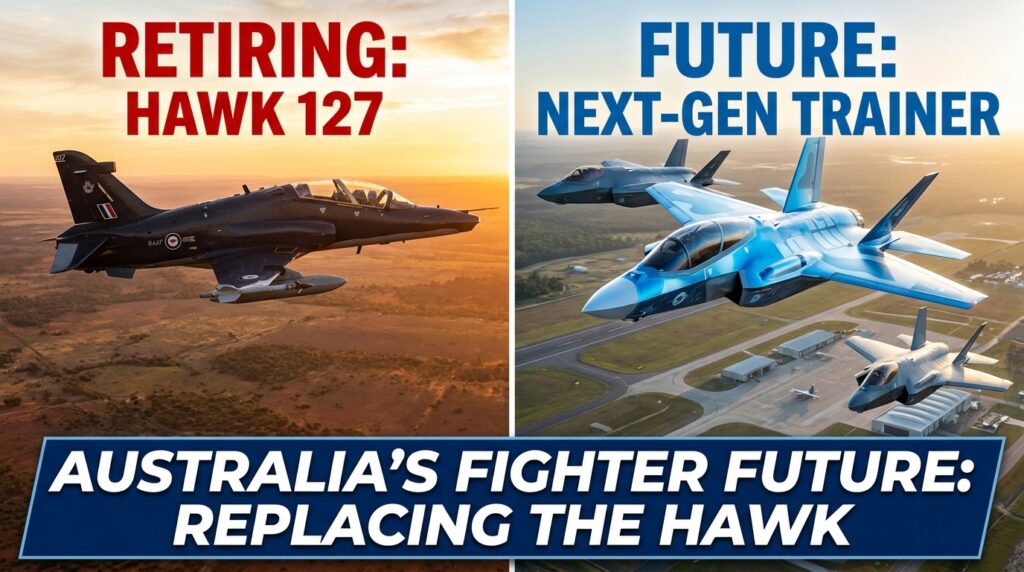
The government has not selected a replacement or published a final shortlist. Defence has instead confirmed that it will assess available options for a future lead-in fighter training capability while maintaining the Hawk during the transition period.
That distinction matters. Australia is planning a complete training system, not holding a simple aircraft contest.
What Is Australia Planning to Replace?
Australia is preparing to replace 33 BAE Systems Hawk 127 lead-in fighter aircraft and their associated training and support systems.
The Hawk sits between basic pilot training and conversion to an operational combat aircraft. RAAF pilots first develop core flying skills on the turboprop-powered PC-21 before moving into the faster Hawk, where they learn the habits needed for frontline fighter operations.
According to the Royal Australian Air Force’s Hawk 127 guide, the aircraft prepares pilots for conversion to:
- F-35A Lightning II
- F/A-18F Super Hornet
- EA-18G Growler
Students complete a 14-week introductory fighter course at RAAF Base Pearce in Western Australia. Training includes formation flying, instrument flying, navigation, night operations, and general fast-jet handling. Graduates then undertake a 20-week course at RAAF Base Williamtown in New South Wales covering air-to-air and air-to-ground weapons training.
The Hawk also supports the preparation of weapon systems officers for the Super Hornet and electronic warfare officers for the Growler. This means its replacement must serve more than student pilots.
Also read – United Plans to Retire 80 Jets as Boeing 737 MAX 10 Arrives
Why Does Australia Need a New Fighter Trainer?
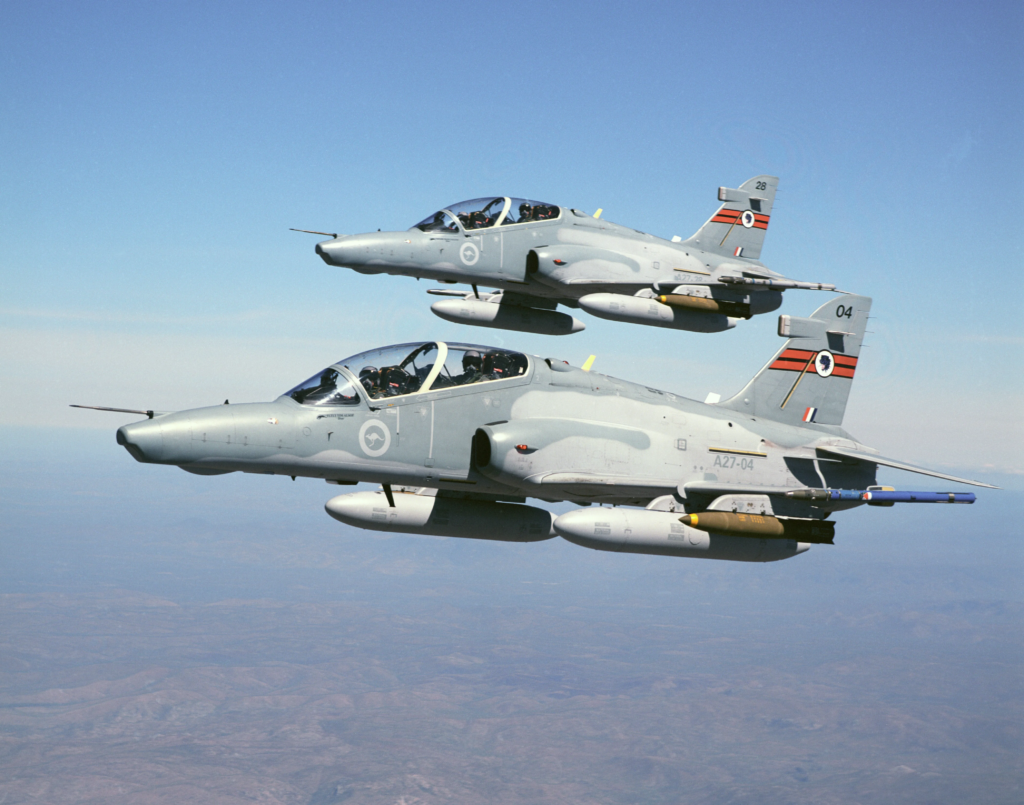
Australia needs a new training system because the Hawk entered RAAF service about 25 years ago and must increasingly prepare crews for aircraft built around sensors, data links, electronic warfare, and highly automated cockpits.
The Hawk remains capable, but the difference between a training aircraft designed in an earlier era and a modern F-35A is substantial. Today’s combat pilots must manage information from multiple sensors, share data with other aircraft and forces, recognize threats quickly, and make decisions before an opponent does.
A replacement system must therefore teach more than aircraft handling.
It will need to develop skills in:
- Sensor and radar management
- Electronic warfare
- Data-link operations
- Simulated weapons employment
- Threat recognition
- Mission planning and debriefing
- Working with crewed and uncrewed aircraft
- Operating in complex multinational exercises
The Hawk already uses simulated radar, weapons, mission recording, multifunction displays, and a head-up display. Its successor must take those functions further and connect live flying more closely with ground simulators and computer-generated threats. The RAAF lists radar and weapon simulation, data links, and mission playback among the Hawk’s current capabilities.
When Will Australia Retire the Hawk 127?
Australia expects to withdraw the Hawk within the next decade, but it has not published a precise retirement year for the entire fleet.
Earlier planning documents listed a 2026 withdrawal date. That schedule changed after the government committed A$1.5 billion over 10 years to upgrade and support the aircraft until 2032.
The 2022 support announcement included:
- Replacement Adour Mk 951 engines
- Continuing aircraft upgrades
- Engineering and certification work
- Maintenance support
- Employment for hundreds of Australian workers
- Continued operations at RAAF Bases Pearce and Williamtown
The government said the contract would keep the Hawk relevant for pilots moving to the F-35A, Super Hornet, and Growler until 2032.
This does not necessarily mean every Hawk will fly until the final day of 2032. Defence may phase aircraft out gradually as the replacement training system becomes operational.
Why Is the Hawk Being Upgraded Before It Is Replaced?
The Hawk is being upgraded because Australia cannot allow a gap in fast-jet training while it selects, buys, tests, and introduces a replacement.
Military aircraft replacement programs take years. Even after the government chooses a platform, the RAAF must prepare bases, train instructors, establish maintenance arrangements, certify local equipment, write course material, and prove that graduates are ready for frontline aircraft.
Keeping the Hawk reliable protects Australia from three major risks:
| Risk | Why it matters |
|---|---|
| Training gap | Pilots cannot move efficiently from the PC-21 to combat aircraft |
| Replacement delay | A new trainer may arrive later than planned |
| Instructor shortage | Experienced personnel must learn the new system while maintaining current courses |
The engine and support investment therefore acts as a bridge. It keeps the existing training pipeline open while Defence develops the future system.
Which Aircraft Could Replace Australia’s Hawk 127?
The Boeing-Saab T-7A Red Hawk, Leonardo M-346, and Korea Aerospace Industries T-50 family are widely viewed as the leading possible candidates, but Australia has not confirmed an official shortlist.
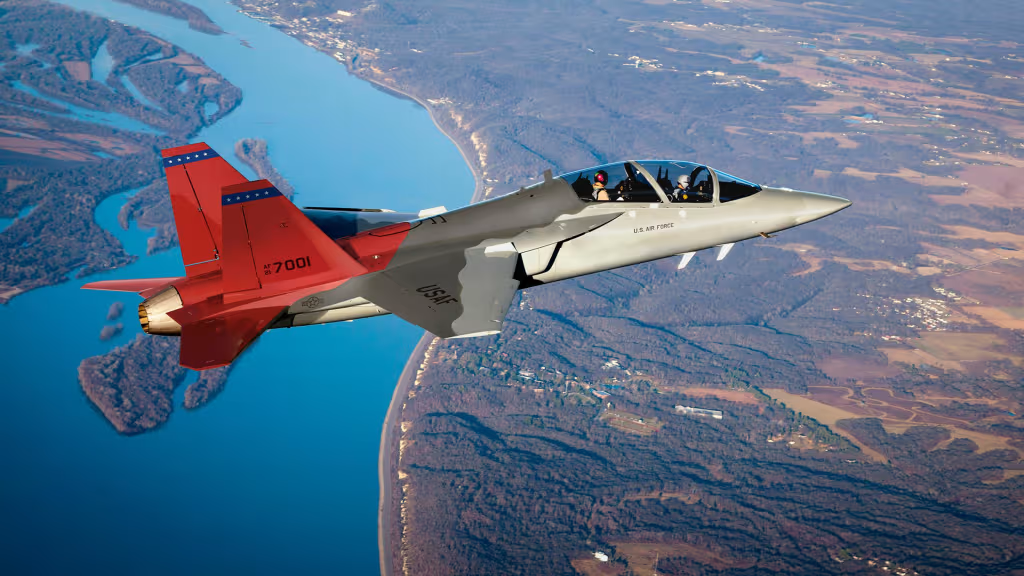
These aircraft were associated with Australia’s earlier market studies and remain among the most established modern advanced jet trainers available.
| Possible contender | Country or partnership | Main strength |
| Boeing-Saab T-7A Red Hawk | United States and Sweden | Modern digital design and alignment with US training |
| Leonardo M-346 Master | Italy | Mature training system with multiple international users |
| KAI T-50 family | South Korea and United States | Supersonic performance and combat-aircraft characteristics |
A previous Australian industry process also drew attention from other suppliers, but the present assessment may not follow the same structure or include exactly the same aircraft.
No contender should be described as the favorite without an official Australian evaluation.
What Is the Boeing-Saab T-7A Red Hawk?
The T-7A is a new-generation advanced trainer developed by Boeing and Saab for the United States Air Force.
Its strongest argument is not simply speed or appearance. The aircraft was designed alongside its digital engineering, simulation, and ground-training environment. That approach could help Australia connect flying instruction with synthetic missions and rapidly updated threat scenarios.
Potential advantages include:
- A modern cockpit
- Digital engineering and support
- Strong compatibility with US training concepts
- Growth potential through software
- A large future customer in the US Air Force
The main issue Australia would examine is maturity. A newer aircraft can offer a longer future life, but it may carry more development, schedule, and early-service risk than a system already operating with several air forces.
Why Could the Leonardo M-346 Appeal to Australia?
The M-346 could appeal because it is already used as an advanced training system and was designed to reproduce many of the cockpit and mission-management demands of modern fighters.
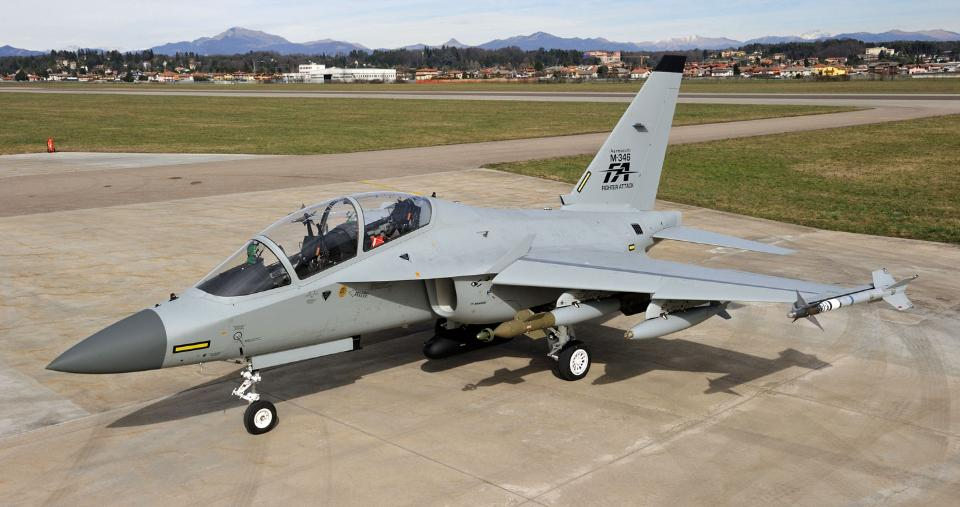
The aircraft supports embedded simulations that allow pilots to train against virtual radar threats, weapons, and targets while flying a real sortie. This can reduce the need to provide actual fighter aircraft or live adversaries for every training event.
Its possible strengths include:
- An established international user base
- Integrated ground-based training
- Embedded tactical simulation
- A twin-engine design
- Experience preparing pilots for advanced combat aircraft
Australia would still need to evaluate operating cost, availability, local support, industrial participation, and how easily the system could be adapted to RAAF requirements.
Why Is the KAI T-50 Family a Serious Option?
The T-50 family is a serious option because it combines advanced training with supersonic performance and handling closer to a light combat aircraft.
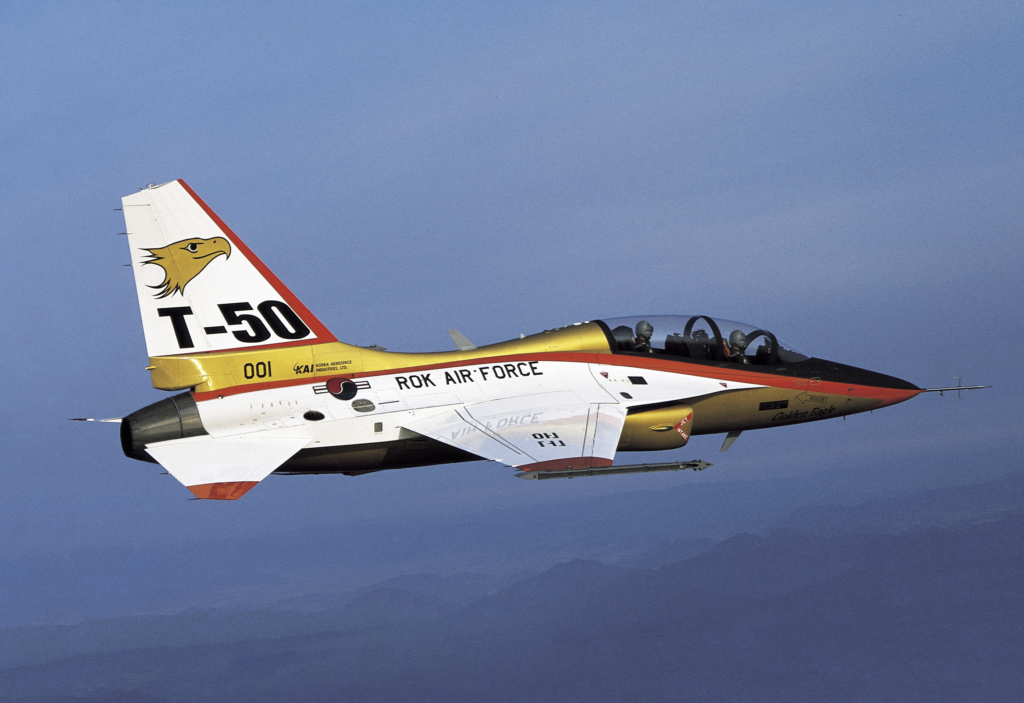
Developed by Korea Aerospace Industries with assistance from Lockheed Martin, the broader family includes training and light-combat variants. That gives the platform a substantial operational history and a clear connection to fighter-style flying.
Its possible advantages include:
- Supersonic speed
- Mature service history
- Fighter-like performance
- Multiple international operators
- Training and light-combat variants
However, the fastest trainer is not automatically the best training system. Australia must decide how much high-speed flying genuinely needs to occur in the training aircraft and how much can be taught more cheaply in simulators or frontline conversion units.
Will Australia Simply Choose the Most Advanced Jet?
No. Australia is more likely to choose the system that produces combat-ready aircrew reliably and affordably, not the aircraft with the most impressive specification sheet.
Defence will need to compare:
- Aircraft purchase cost
- Cost per flying hour
- Maintenance burden
- Simulator quality
- Aircraft availability
- Instructor workload
- Software upgrade speed
- Australian industry involvement
- Compatibility with allied training
- Delivery risk
- Engine and spare-parts supply
- Ability to reproduce future threats
A sophisticated aircraft that spends too much time waiting for parts would weaken the training pipeline. A cheaper jet with poor simulation or limited mission systems could push too much instruction onto expensive frontline fighters.
The strongest bid must balance both sides.
Why Simulators May Matter as Much as the New Aircraft
Simulators may determine the success of the replacement because modern tactical training cannot be conducted entirely in real airspace.
Live flying remains essential for aircraft handling, decision-making under pressure, weather experience, formation work, and human performance. But synthetic training can reproduce situations that are too dangerous, costly, classified, or geographically difficult to create regularly.
A modern system could allow students to practise:
- Dense missile threats
- Electronic attack
- Large formations
- Contested communications
- Long-range weapons
- Coordinated missions with naval and land forces
- Operations alongside virtual F-35s and uncrewed aircraft
A pilot might fly one real trainer while seeing computer-generated friendly and hostile aircraft through the cockpit systems. Instructors could then replay every decision during debriefing.
This is why readers should judge the future program by the aircraft and the ground-training package.
How Does the F-35 Change Australia’s Training Needs?
The F-35 changes the training requirement because its pilot must manage information and tactics as well as fly the aircraft.
Australia completed delivery of its planned fleet of 72 F-35As in December 2024. The aircraft now operates alongside the Super Hornet and Growler as a central part of the country’s air-combat force.
A student progressing toward the F-35 must learn to:
- Build a clear picture from several sensors
- Decide which information matters
- Share targeting data with other forces
- Operate without revealing unnecessary information
- Respond to electronic and missile threats
- Manage a complex mission while flying safely
The future trainer does not need to duplicate the F-35. It must prepare pilots to learn the F-35 efficiently without using costly frontline aircraft for lessons that could have been completed earlier.
Could Australia Skip a Jet Trainer and Use More Simulation?
Australia could move some instruction into simulators, but a complete removal of advanced live-flying training would create significant practical risks.
Students still need real experience with:
- High-speed decision-making
- G-forces
- Formation flying
- Weather
- Aircraft emergencies
- Landing under pressure
- Instructor interaction in flight
- Managing physical workload
The more realistic question is not whether Australia will eliminate the jet trainer. It is how many skills should be taught in the aircraft, in a simulator, or directly on an operational fighter.
Getting that balance right can save money without reducing pilot quality.
Where Will the New Trainer Be Based?
RAAF Bases Pearce and Williamtown are the logical locations, but Defence has not confirmed the final basing arrangement for the replacement.
The current Hawk fleet is operated by:
- No. 79 Squadron at RAAF Base Pearce
- No. 76 Squadron at RAAF Base Williamtown
BAE Systems supports the aircraft, while CAE supports three full-mission Hawk simulators.
Keeping the future system at these bases would preserve established training areas, infrastructure, instructors, maintenance experience, and local industry jobs. A new aircraft could still require substantial construction, including:
- Simulator buildings
- Secure mission-planning facilities
- Maintenance hangars
- New training classrooms
- Software-support areas
- Aircraft shelters
- Ground equipment
- Fuel and safety upgrades
The infrastructure decision may be almost as important to local communities as the aircraft selection.
What Could the Hawk Replacement Cost?
Australia has not announced a confirmed budget for the new training system, and simple aircraft price comparisons would be misleading.
The final cost could include:
- Aircraft
- Spare engines
- Simulators
- Training devices
- Base construction
- Weapons-training equipment
- Instructor preparation
- Technical data
- Software support
- Maintenance tools
- Initial spare parts
- Decades of sustainment
A headline figure based only on the number of jets would leave out much of the real program.
Defence will also need to decide whether it buys the aircraft outright, contracts part of the training service, or uses a mixed model involving government and industry personnel.
What Could Delay the Hawk Replacement?
The biggest risks are procurement delays, immature aircraft, infrastructure work, instructor availability, and failure to keep the Hawk reliable during transition.
A practical replacement plan must avoid a “training valley,” where the old system becomes difficult to operate before the new one can train enough students.
Key warning signs would include:
- A selection decision arriving too late
- Delayed aircraft certification
- Simulator software falling behind aircraft delivery
- A shortage of qualified instructors
- New facilities not being ready
- Hawk availability dropping faster than expected
- Too few aircraft ordered to meet training demand
The transition should overlap. Instructors will need time to learn the new system while Hawk courses continue.
What Does the Decision Mean for Australian Defence Industry?
The program could support decades of Australian work in maintenance, simulation, software, engineering, and training services.
Australia is unlikely to build an entirely new trainer from the ground up, but local industry could still play a major role in:
- Aircraft sustainment
- Simulator operation
- Mission-data development
- Software integration
- Component repair
- Instructor support
- Base services
- Engineering certification
The existing Hawk support contract demonstrates the scale of this work. The government said the A$1.5 billion extension would sustain 350 direct positions and support up to 900 direct and indirect jobs.
A strong bid will therefore need to explain not only where the aircraft is manufactured, but how Australia can operate and upgrade it during its full service life.
Australia’s Hawk Replacement in One Table
| Key question | Direct answer |
| What is being replaced? | The RAAF’s 33 Hawk 127 aircraft and training system |
| Why replace it? | Age, future training demand, and modern combat complexity |
| Has a winner been selected? | No |
| Is there an official shortlist? | No public final shortlist |
| When will the Hawk retire? | Within the next decade, with support funded to 2032 |
| Who are the likely contenders? | T-7A, M-346, and T-50 family |
| Will Australia buy only aircraft? | No, the program requires a complete training system |
| Where are Hawks based? | RAAF Bases Pearce and Williamtown |
| What matters most? | Training quality, availability, cost, simulation, and delivery risk |
What Happens Next?
The next meaningful step will be a formal definition of Australia’s requirements, followed by industry proposals, evaluation, and government approval.
Readers should watch for:
- A formal request for tender
- A confirmed shortlist
- Required aircraft numbers
- Simulator and training specifications
- Australian industry commitments
- Base infrastructure funding
- A contract decision
- Initial operating capability date
- Hawk retirement schedule
Until those details are announced, claims that one aircraft has “won” or is the definite favorite remain speculative.
Final Verdict: Australia Is Replacing a Training Pipeline, Not Just a Jet
Australia’s Hawk replacement will shape how the RAAF prepares fighter pilots and aircrew for decades.
The Hawk 127 continues to provide the bridge between the PC-21 and frontline combat fleets, but future students will need deeper training in sensors, electronic warfare, data sharing, and complex mission management.
The aircraft choice will attract the headlines. The more important questions concern the entire system: Can it keep enough aircraft available, connect live and simulated training, prepare students for the F-35 and Growler, and evolve as future threats change?
That is the standard Australia’s next fighter trainer must meet.