
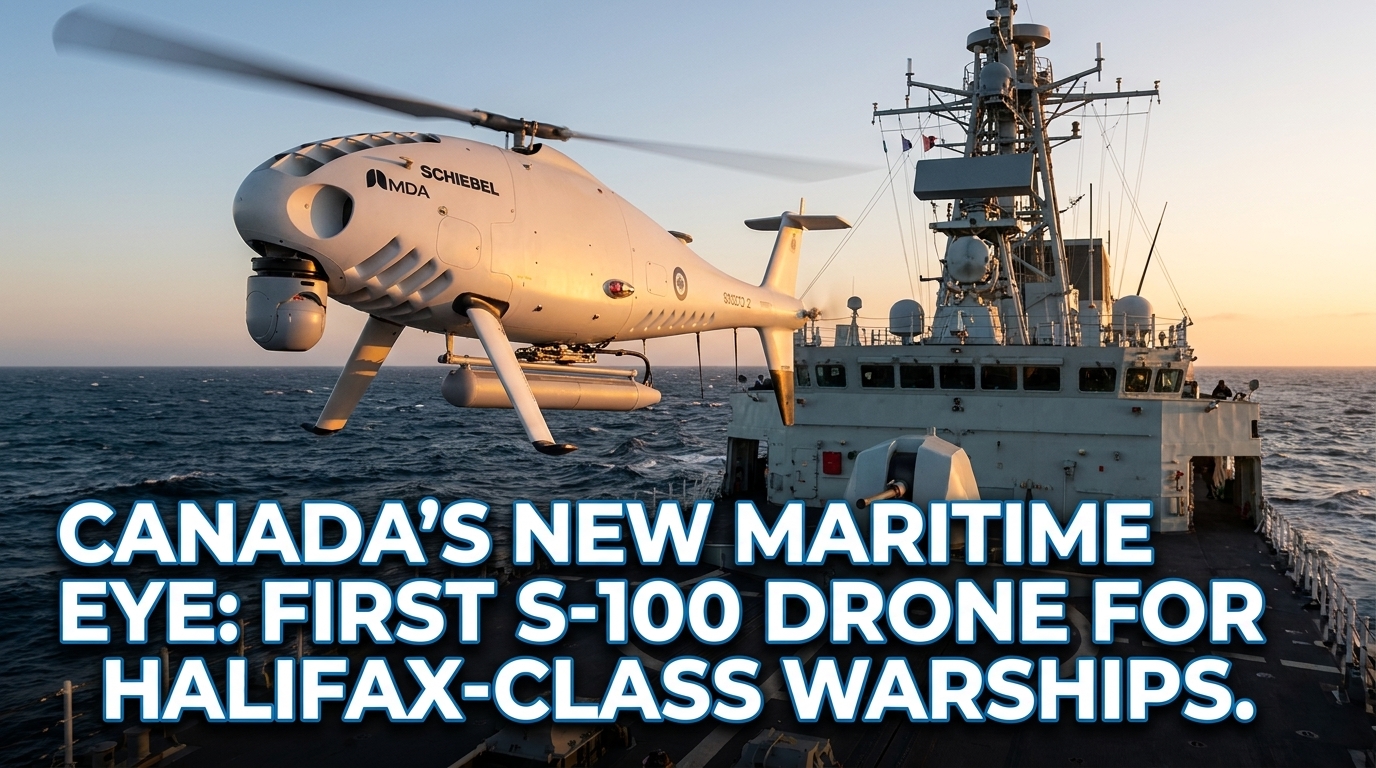


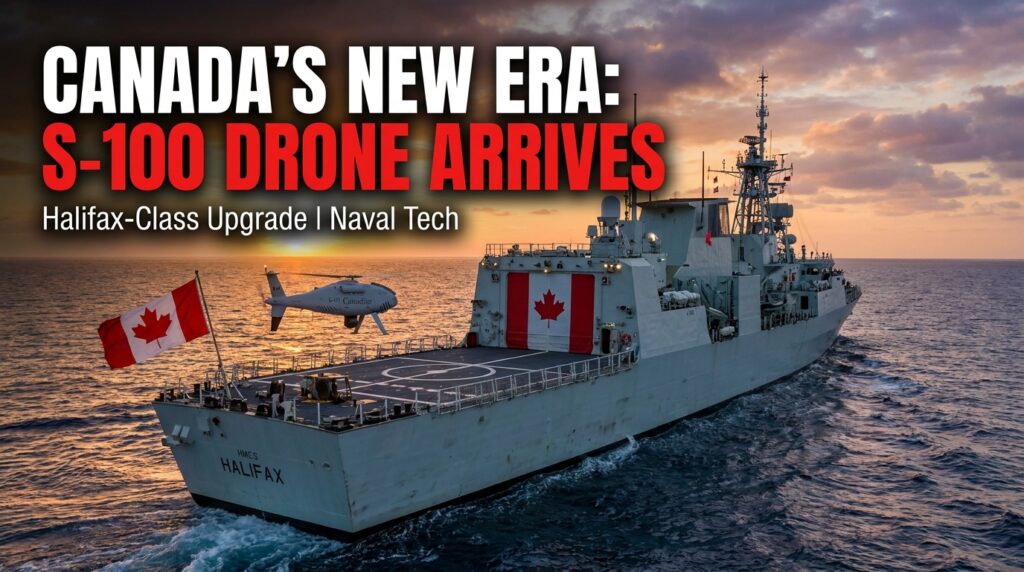
Canada has accepted its first Schiebel Camcopter S-100 maritime drone, marking a major step in the Royal Canadian Navy’s plan to extend surveillance far beyond the visible horizon of its Halifax-class frigates.
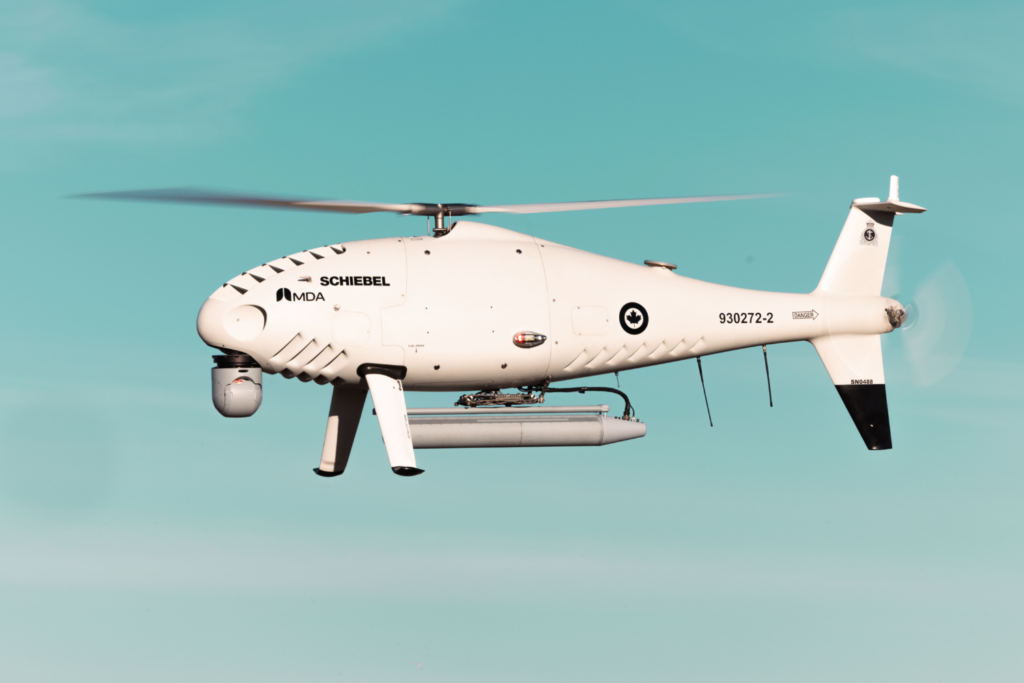
The helicopter-shaped uncrewed aircraft will support intelligence gathering, surveillance, target detection and reconnaissance at sea. It can launch vertically from a ship’s flight deck, remain airborne without putting a pilot at risk and send live sensor information back to the vessel.
For the Royal Canadian Navy, the most important benefit is simple: a frigate will be able to see, identify and track activity much farther away without immediately sending a crewed helicopter.
What has Canada received?
Canada has received the first S-100 aircraft connected to its new shipborne uncrewed aircraft programme.
The Canadian government awarded two contracts to MDA Space in August 2025 to provide the Royal Canadian Navy with up to six uncrewed aircraft systems for Halifax-class frigates. The initial acquisition covers two systems, with options for four more. The first acquisition contract was valued at about C$39 million, including taxes. An initial five-year support contract was estimated at C$27 million, with options to extend support for up to 20 years.
The aircraft itself is supplied by Austrian manufacturer Schiebel, while MDA Space leads the Canadian programme and system integration.
A typical operational system is more than one flying vehicle. It normally includes:
- Two S-100 aircraft
- Ground or shipboard control equipment
- Sensor-control workstations
- Communications links
- Tracking antennas
- Spare parts and maintenance support
Schiebel describes two aircraft per system as a way to improve availability, allowing one vehicle to remain ready while the other is being serviced or prepared for a different mission.
What is the Camcopter S-100?
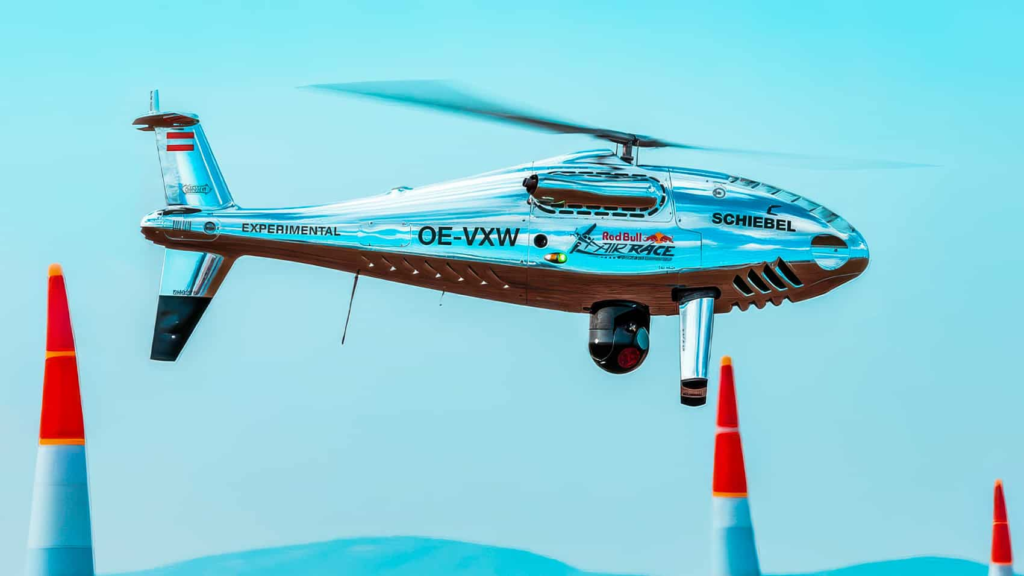
The Camcopter S-100 is a pilotless vertical-takeoff aircraft designed to operate from ships and small land sites.
It looks like a compact helicopter, but it does not carry a pilot or passengers. Missions are controlled from onboard workstations, while the aircraft can follow pre-programmed routes using GPS waypoints.
Its ability to take off and land vertically is critical for naval use. A fixed-wing drone normally needs a runway, launcher or recovery system. The S-100 can operate from a ship’s existing flight deck, making it more practical for a frigate working hundreds of kilometres from land.
According to Schiebel, the aircraft has:
| S-100 specification | Published figure |
|---|---|
| Maximum takeoff weight | 200kg |
| Length | 3.11m |
| Rotor diameter | 3.4m |
| Maximum dash speed | 120 knots |
| Main payload-bay capacity | Up to 50kg |
| Operational use | Day and night |
These figures are manufacturer specifications and may vary depending on the selected sensors, fuel load, weather and mission profile.
How far can Canada’s S-100 drone see?
Canada expects the S-100 system to provide real-time surveillance information at distances of up to 100 nautical miles from the ship.
That equals about 185km, although actual performance will depend on communications, sensor selection, weather, altitude and operational restrictions.
This range matters because a frigate’s crew cannot rely on eyesight alone. Even powerful ship-mounted sensors can be affected by the curvature of the Earth, low-flying objects, sea conditions and the size of a target.
By placing cameras and radar in the air, the ship gains a much wider viewing position.
A practical example helps explain the difference. A lookout standing on a ship may see another vessel at a limited distance, depending on visibility and height. A drone flying above the sea can look beyond that immediate area and investigate a contact before the frigate approaches it.
The S-100 does not magically make the ocean transparent, but it gives commanders more time to identify an object, assess its behaviour and decide what to do next.
What sensors will Canada use on the S-100?
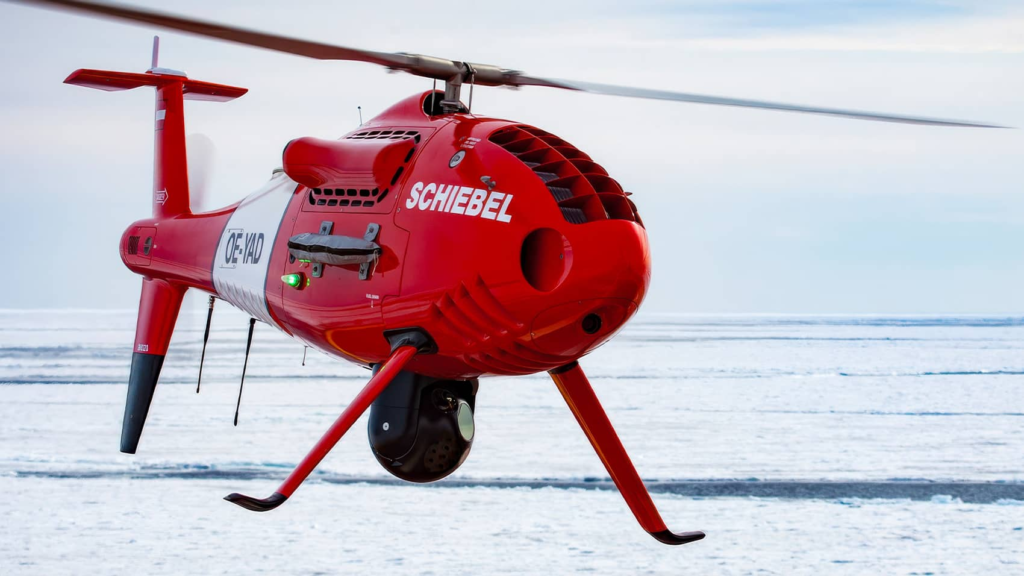
The Canadian S-100 system is designed to combine several sensors rather than depend on a single camera.
Schiebel said the proposed Canadian configuration supports:
- Electro-optical cameras for detailed daytime imagery
- Infrared sensors for night operations and heat detection
- Maritime radar for finding vessels across large areas
- Automatic Identification System receivers for reading ship identity broadcasts
- Identification Friend or Foe equipment for supporting military identification
Together, these systems can help crews compare what a vessel claims to be with what the drone’s sensors actually observe.
For example, a ship may transmit an identity through the Automatic Identification System. Radar can show its position and movement, while a camera can provide visual confirmation.
The useful information comes from combining those results.
Why is the S-100 useful on a Halifax-class frigate?
The S-100 gives a Halifax-class frigate an additional airborne surveillance option without using a crewed helicopter for every task.
Canada’s Halifax-class ships can operate CH-148 Cyclone helicopters, which provide considerably greater payload, range and mission capability. The S-100 is not a replacement for those aircraft.
Instead, it can handle missions where a smaller uncrewed platform is safer, more efficient or easier to deploy.
Possible tasks include:
- Investigating unidentified vessels
- Monitoring suspicious maritime activity
- Searching coastal areas and shipping routes
- Tracking a vessel without moving the frigate closer
- Supporting search-and-rescue operations
- Providing imagery during boarding operations
- Watching an area for extended periods
- Supporting targeting and tactical decision-making
The drone may also allow the Cyclone helicopter to remain available for missions that need a crew, larger sensors, greater payload or direct human judgement.
Also read – Australia Moves to Replace Its Hawk 127 Fighter Trainers
Will Canada arm the S-100?
Canada’s announced programme focuses on surveillance, reconnaissance and target acquisition, not on using the S-100 as an armed attack aircraft.
The word “targeting” can cause confusion. In military use, target acquisition often means locating, identifying and tracking something accurately enough for commanders to understand the situation. It does not automatically mean the drone carries weapons.
The Canadian government has described the programme as an Intelligence, Surveillance, Target Acquisition and Reconnaissance system, commonly shortened to ISTAR.
Based on the publicly announced configuration, the S-100’s main value lies in its sensors and the information it sends back to the ship.
Can the S-100 fly in bad weather?
The S-100 is designed for demanding maritime conditions, but no small aircraft is unaffected by weather.
Schiebel describes the platform as capable of operating during day and night and in varied weather conditions. The S-100 has also been deployed from more than 50 vessels worldwide, according to the manufacturer.
However, naval operators will still consider:
- Wind speed and direction
- Ship movement
- Visibility
- Freezing conditions
- Saltwater exposure
- Sensor performance
- Deck safety
- Communications reliability
Landing a small rotorcraft on a moving ship is one of the hardest parts of maritime aviation. The deck may rise, fall and roll while the aircraft approaches, particularly in rough seas.
This is why successful acceptance of an aircraft is only one programme milestone. Canada must also validate ship integration, crew training, operating limits and maintenance procedures.
What does “Canada accepts its first S-100” actually mean?
Acceptance means the aircraft has passed an agreed contractual stage, but it does not necessarily mean the system is already conducting routine missions from an operational frigate.
Military equipment normally moves through several steps:
- The manufacturer completes the aircraft.
- Initial inspections and tests are conducted.
- The customer formally accepts the equipment.
- Canadian-specific sensors and communications are checked.
- Sailors and maintainers are trained.
- Shipboard trials confirm safe operation.
- The system reaches initial operational capability.
- Wider fleet deployment follows.
Readers should therefore avoid treating “first acceptance” and “fully operational” as the same event.
The most revealing milestones will come when the Royal Canadian Navy confirms successful deck operations, integration with ship combat systems and deployment on an active mission.
How could the S-100 help during a real maritime operation?
The S-100 could help a frigate investigate a distant contact without exposing a helicopter crew or changing the ship’s position immediately.
Imagine a Canadian frigate receiving an incomplete report about a vessel operating beyond normal visual range.
Instead of sailing directly toward it, the ship could launch the S-100. The drone could:
- Fly towards the reported position
- Search with radar
- Compare the vessel against identification broadcasts
- Capture daylight or thermal imagery
- Report its direction and speed
- Continue monitoring while the frigate remains farther away
The commanding officer would then have better information before deciding whether to approach, warn, monitor or send a boarding team.
That is the S-100’s real strength. It creates decision-making time.
Could the S-100 support search-and-rescue missions?
The S-100 can support search-and-rescue operations by carrying cameras or radar over areas that are difficult to inspect from a ship.
A drone could search ahead of a vessel, examine debris fields or use thermal sensors to look for a person in the water.
However, it cannot replace rescue helicopters, boats or trained medical personnel. It can help find someone, but it cannot normally lift a survivor from the sea.
Schiebel lists search and rescue as one of the aircraft’s potential missions, particularly when equipped with wide-area cameras or radar.
For naval planners, the strongest use is likely to be rapid detection followed by a coordinated response from crewed aircraft or rescue vessels.
What are the main limitations of a small maritime drone?
The S-100 expands a ship’s reach, but it does not eliminate the limits of endurance, communications, payload and weather.
The most important constraints include:
1. It depends on reliable communications
Live imagery and sensor data must travel back to the ship. Interference, distance, terrain and hostile electronic activity can affect the link.
2. Payload choices involve trade-offs
Adding a radar, camera or other equipment affects weight, fuel and endurance. A drone cannot carry every available sensor at maximum capacity during every mission.
3. Saltwater causes maintenance pressure
Sea spray, humidity and corrosion create demanding conditions for engines, electronics and moving components.
4. Shipboard recovery remains complex
Launching is only half the task. The aircraft must return and land safely on a moving deck.
5. It cannot replace human judgement everywhere
A remote sensor can provide excellent imagery, but crews still need to interpret unclear behaviour, civilian activity and changing tactical conditions.
What should observers watch next?
The next important stage is successful integration aboard a Halifax-class frigate, not simply the delivery of additional aircraft.
Five developments will show whether the programme is progressing as planned:
- Completion of Canadian acceptance testing
- Training of Royal Canadian Navy operators
- Safe launch and landing trials at sea
- Integration with frigate combat-management systems
- Confirmation of initial operational capability
Canada’s earlier procurement announcement described an initial purchase of two systems with options for four additional systems. Each system is expected to include two aircraft, according to a Royal Canadian Navy update.
That structure gives Canada the option to expand gradually after the first systems demonstrate reliable operational performance.
Why the S-100 matters for Canada’s three-ocean navy
The S-100 matters because Canada must monitor vast maritime areas across the Atlantic, Pacific and Arctic approaches with a limited number of ships and aircraft.
A small ship-launched drone cannot solve that challenge alone. It can, however, extend each frigate’s awareness without requiring another large crewed aircraft to remain constantly airborne.
The system may be particularly useful where:
- The operating area is remote
- Weather changes quickly
- Contacts are spread over a large area
- A ship needs persistent surveillance
- Crewed aviation resources are limited
- Commanders need to investigate without escalating a situation
The aircraft also reflects a wider naval shift. Modern warships increasingly rely on a mix of crewed and uncrewed systems, allowing commanders to place sensors farther away while keeping people out of unnecessary danger.
The bottom line
Canada’s acceptance of its first S-100 is an important hardware milestone, but the programme’s real value will be proven at sea.
The Camcopter can give Halifax-class frigates a wider field of view, persistent airborne surveillance and a lower-risk way to investigate distant maritime contacts.
Its success will depend on more than the aircraft itself. Canada must make the sensors, data links, ship systems, operators and maintenance network work together reliably in difficult ocean conditions.
When that happens, the S-100 will function less like a small helicopter and more like a movable observation post in the sky, giving Canadian sailors information earlier and helping commanders make better decisions before a distant contact becomes an immediate threat.
Frequently Asked Questions About Canada’s S-100 Drone
What is the S-100 drone used for?
The S-100 is used for maritime surveillance, reconnaissance, vessel detection, identification support and target tracking.
Which Canadian ships will use the S-100?
Canada plans to operate the system from Royal Canadian Navy Halifax-class frigates.
Does the S-100 need a runway?
No. It takes off and lands vertically from a ship’s flight deck or a small prepared area.
How far can Canada’s S-100 operate from a ship?
The selected system is intended to provide surveillance awareness at distances of up to 100 nautical miles, or about 185km, from the ship.
Is the S-100 replacing the CH-148 Cyclone?
No. It complements crewed helicopters by performing smaller surveillance and reconnaissance missions.
Is Canada buying six individual drones?
Canada announced up to six uncrewed aircraft systems. Royal Canadian Navy information indicates that each system includes two air vehicles, meaning the eventual number of aircraft could be higher than six if all options are exercised.