
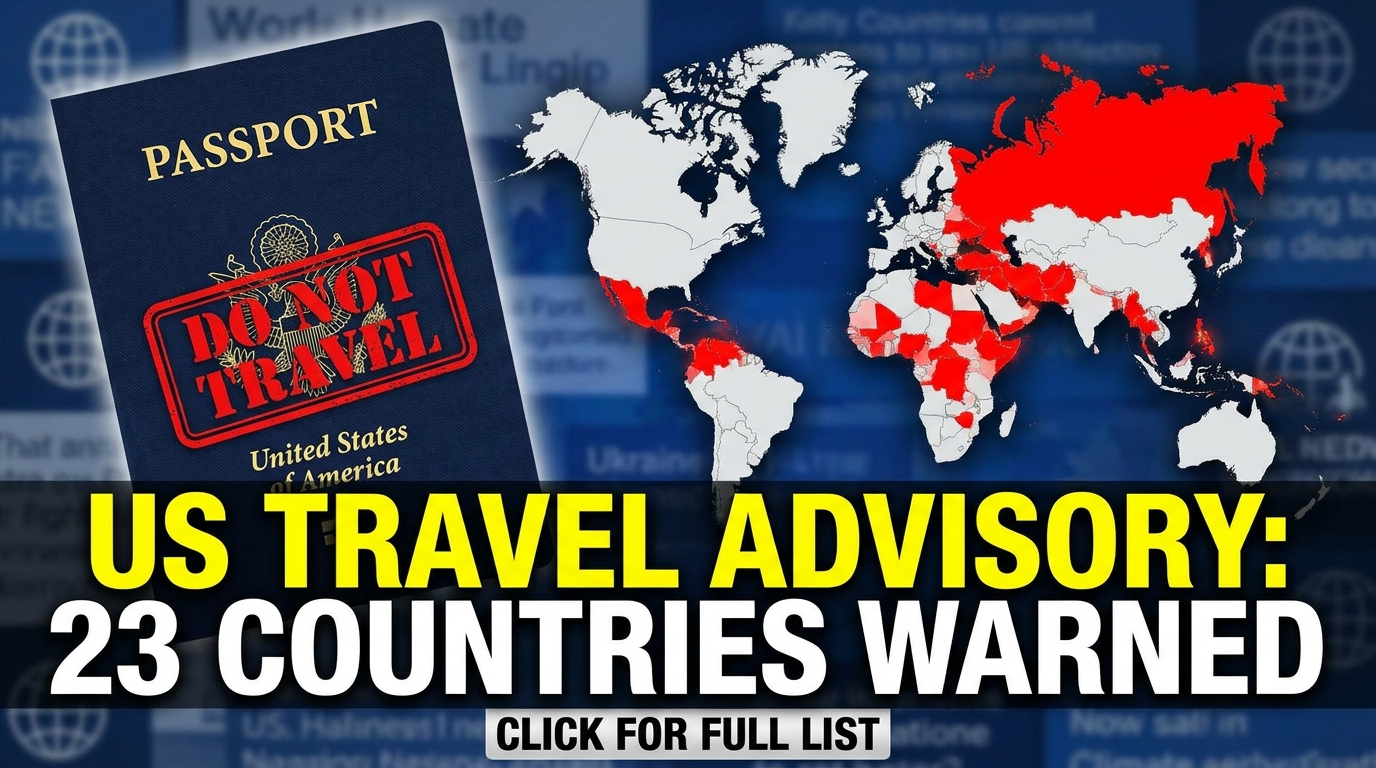


The United States currently advises Americans not to visit 23 countries because travelers could face war, terrorism, kidnapping, wrongful detention, violent crime, disease outbreaks or severely limited emergency assistance.
The warning is the highest level in the U.S. Department of State’s travel advisory system. It does not merely ask visitors to be more careful. Level 4: Do Not Travel means Americans should avoid the destination or leave when it is safe to do so.
The current list includes countries across Africa, Asia, Europe, the Caribbean and the Middle East. Some have active conflicts. Others present a serious risk of detention, kidnapping or medical emergencies in places where the U.S. government may be unable to provide meaningful help.
Which 23 Countries Are on the US Do Not Travel List?
The 23 destinations currently carrying a nationwide Level 4 advisory are Afghanistan, Belarus, Burkina Faso, Burma, the Central African Republic, Chad, the Democratic Republic of the Congo, Haiti, Iran, Iraq, Lebanon, Libya, Mali, Niger, North Korea, Russia, Somalia, South Sudan, Sudan, Syria, Uganda, Ukraine and Yemen.
The list below reflects the U.S. Department of State travel advisory database checked on July 16, 2026.
| Region | Level 4 countries |
|---|---|
| Africa | Burkina Faso, Central African Republic, Chad, Democratic Republic of the Congo, Libya, Mali, Niger, Somalia, South Sudan, Sudan, Uganda |
| Middle East | Iran, Iraq, Lebanon, Syria, Yemen |
| Asia | Afghanistan, Burma, North Korea |
| Europe | Belarus, Russia, Ukraine |
| Caribbean | Haiti |
Africa accounts for 11 of the 23 destinations, largely because of armed conflict, terrorism, kidnapping, political instability, weak medical systems and limited government control in some regions.
What Does a Level 4 Travel Advisory Mean?
Level 4 means the destination presents life-threatening risks and the U.S. government may have little or no ability to assist during an emergency.
The State Department’s advisory guide defines four levels:
- Level 1: Exercise normal precautions
- Level 2: Exercise increased caution
- Level 3: Reconsider travel
- Level 4: Do not travel
Level 4 is not the same as a legal ban in every case. An American may still find a flight or hold a valid visa, but that does not make the journey safe or guarantee consular assistance.
A traveler arrested in a country without normal U.S. diplomatic services, for example, may not receive a routine consular visit. A person injured in an active conflict zone may find that ambulances, hospitals, roads and airports are unavailable. Travel insurance may also exclude incidents connected to war, civil unrest or travel against government advice.
Also read – U.S. Domestic Travel Trends 2026: How America 250th Birthday Is Changing Trips
Why Is the US Warning Against Travel to These Countries?
The reasons differ by destination, but the most serious risks include armed conflict, terrorism, kidnapping, wrongful detention, violent crime and unavailable medical care.
The State Department uses specific warning indicators to explain each advisory:
| Indicator | What it means for travelers |
| Crime | Violent or organized crime could affect visitors |
| Terrorism | Attacks have occurred or credible threats exist |
| Unrest | Protests, instability or armed clashes may threaten safety |
| Health | Disease or weak medical facilities could put lives at risk |
| Kidnapping | Criminal or armed groups may abduct travelers |
| Wrongful detention | Authorities may detain U.S. citizens without fair grounds |
| Natural disaster | Ongoing hazards may disrupt safety and essential services |
| Other | A serious risk does not fit the standard categories |
Several countries carry more than one risk indicator. That matters because a carefully chosen hotel cannot solve dangers such as airspace closures, arbitrary detention, regional fighting or the absence of emergency medical evacuation.
Africa Has the Largest Share of Level 4 Destinations
Eleven African countries are on the nationwide Do Not Travel list, but the reasons are not identical.
Burkina Faso, Mali and Niger
Terrorist attacks, kidnapping and political instability make travel across much of the central Sahel exceptionally dangerous.
Armed groups operate across borders and may target government buildings, hotels, transport routes, religious sites and places visited by foreigners. Overland travel can become dangerous with little warning, while an apparently open road on a map may pass through an area outside effective government control.
Somalia, Sudan and South Sudan
Conflict, kidnapping and weak emergency infrastructure create risks that ordinary trip planning cannot control.
In these environments, flights may stop, border crossings may close and local communication networks may fail. A traveler cannot assume that a nearby airport will remain accessible during an evacuation.
Democratic Republic of the Congo
The Democratic Republic of the Congo carries a Level 4 advisory following security and health concerns, including the current Ebola emergency.
The State Department’s live advisory list showed the DRC at Level 4 with an update dated July 15, 2026. Separate U.S. restrictions introduced during the outbreak have also affected the ability of Americans recently in the country to return immediately on commercial flights.
This creates a useful lesson for travelers and aid workers: entry rules are only half of the journey. Always confirm whether a health emergency could also affect departure, transit or return-home arrangements.
Uganda
Uganda is also listed at Level 4 nationally in the current State Department database.
That does not mean every location presents the same immediate conditions, but travelers should follow the nationwide rating rather than assuming a familiar safari route or established lodge removes broader security and health risks. The advisory database listed Uganda at Level 4 with a December 8, 2025 update.
Also read – US Travel Warnings Tighten for Caribbean and Mexico Trips
Why Are Russia, Belarus and Ukraine on the Do Not Travel List?
War, detention risks and limited U.S. assistance make travel to Russia, Belarus and Ukraine unsafe.
Ukraine remains exposed to military strikes and rapidly changing security conditions. Russia presents serious concerns that include wrongful detention and the limited ability of U.S. officials to help citizens. Belarus also carries a nationwide Level 4 advisory.
A common mistake is assuming a city far from a front line is automatically safe. Modern conflict affects more than battlefields. It can disrupt:
- Commercial flights
- Airspace access
- Banking and card payments
- Mobile communications
- Border crossings
- Fuel supplies
- Consular operations
- Medical evacuation routes
A functioning hotel and available flight do not cancel a Level 4 warning. They only show that some commercial services are operating at that moment.
Why Are Iran and North Korea Especially Risky for Americans?
The danger in Iran and North Korea includes wrongful detention and extremely limited U.S. consular support.
Travelers sometimes believe that avoiding protests, political conversations and photography will remove the risk. It does not. Ordinary actions, professional backgrounds, dual nationality, previous military service or digital material stored on a phone can receive scrutiny that visitors did not expect.
North Korea also has a separate U.S. passport restriction. A standard American passport is generally not valid for travel to, in or through North Korea unless the State Department grants special validation for a limited purpose.
For destinations with a wrongful-detention risk, travelers should understand that:
- Local authorities may not recognize dual U.S. citizenship
- U.S. officials may receive delayed or denied access
- Legal standards may differ sharply from those in the United States
- Private messages and social media activity may be examined
- An arrest may become a diplomatic matter rather than a routine legal case
Is Haiti Still Under a Level 4 Travel Warning?
Yes. Haiti remains at Level 4 because of crime, kidnapping, terrorism, unrest and limited health care.
The official Haiti travel advisory says the country has remained under a national state of emergency since March 2024. The advisory was updated on July 10, 2026, without changing its Level 4 status.
Travelers should not treat proximity to an airport, aid compound or familiar neighborhood as proof that departure will remain possible. Gang activity, road closures and fuel shortages can cut access between two nearby locations.
Is Nigeria on the US Do Not Travel List?
Nigeria is not currently under a nationwide Level 4 advisory. It is listed nationally at Level 3: Reconsider Travel, with several states and regions carrying Level 4 instructions.
This distinction is important because reports about “countries Americans must not visit” sometimes blur nationwide ratings with regional warnings.
The State Department currently tells travelers not to visit several Nigerian states and areas because of terrorism, crime and kidnapping. However, the country’s overall advisory remains Level 3.
The same rule applies elsewhere: check both the national rating and the detailed regional restrictions.
Is Venezuela on the Level 4 List?
Venezuela is currently listed nationally at Level 3, although parts of the country carry Level 4 instructions.
The Venezuela advisory tells Americans not to travel to the Venezuela-Colombia border region and Amazonas state because of kidnapping, terrorism and other security risks. The nationwide level shown in the current database is Level 3.
This is another reason readers should verify viral lists against the official database. Advisory levels can change, and a country may contain several different ratings.
What Should You Do If You Already Booked a Level 4 Destination?
Do not cancel blindly, but stop making additional non-refundable payments until you understand your options.
Follow these steps:
1. Read the complete advisory
Open the destination page in the official State Department database. Note the advisory date, risk indicators, restricted areas and limits on U.S. government assistance.
2. Contact the airline before cancelling online
Ask whether the airline offers:
- A travel waiver
- A destination change
- A credit
- A refund after a schedule change
- Rerouting through another country
Cancelling through the app too early can sometimes turn a potentially refundable disruption into a voluntary cancellation.
3. Read the insurance policy’s exact wording
Search the policy for:
- Government travel advisory
- War or civil unrest
- Terrorism
- Known event
- Evacuation
- Trip interruption
- Cancel for any reason
A Level 4 advisory does not automatically guarantee a payout. Coverage depends on when the policy was purchased, when the advisory changed and which insured event caused the cancellation.
4. Contact the accommodation in writing
Ask whether the booking can be moved to new dates or transferred to another property. Keep every response by email or in-app message rather than relying on a phone promise.
5. Check whether your route enters a Level 4 area
A trip may involve a Level 2 or Level 3 country but pass through a Level 4 region during a transfer, excursion or road journey.
What Should Americans Do If They Are Already in a Level 4 Country?
Leave when the State Department advises departure and when a safe commercial option exists. Do not wait for a government evacuation unless officials specifically announce one.
Immediate actions should include:
- Enroll in the Smart Traveler Enrollment Program to receive embassy alerts.
- Keep passports, medication, cash and charging equipment together.
- Identify at least two exit routes.
- Avoid demonstrations, government buildings and military locations.
- Tell a trusted person your location and daily check-in time.
- Save embassy and emergency details offline.
- Keep the vehicle fuelled where driving remains safe.
- Do not post your live location publicly.
A useful emergency bag should contain more than clothing. Include copies of identity documents, essential prescriptions, a power bank, water, basic food, local cash and a written contact list. Phones can be lost, searched, damaged or disconnected.
What Not to Do in a High-Risk Destination
Do not assume experience, confidence or local contacts make you immune to a Level 4 risk.
Avoid these common errors:
- Entering because a friend says the capital feels normal
- Depending on one driver or one border crossing
- Carrying sensitive work files on a phone or laptop
- Photographing military sites, checkpoints or protests
- Using visible satellite equipment without checking local law
- Waiting until violence begins to buy an outbound ticket
- Assuming an employer will arrange evacuation
- Believing travel insurance covers every security incident
- Posting hotel names and daily movements online
Journalists, aid workers, researchers and dual nationals can face risks different from those of leisure visitors. Their planning should include professional security advice, communications protocols and a documented evacuation threshold.
Does the US Do Not Travel List Change?
Yes. Advisory levels can change whenever security, health, diplomatic or operating conditions change.
The State Department says it reviews Levels 3 and 4 at least every six months and can update an advisory sooner when conditions change substantially. That includes changes to embassy staffing or restrictions placed on U.S. government employees.
A screenshot from last month is therefore not enough. Travelers should check again:
- Before paying
- Before the refund deadline
- Seven days before departure
- Twenty-four hours before departure
- During the trip
The Bottom Line
The 23-country Do Not Travel list identifies destinations where ordinary travel precautions are not enough to manage the danger.
The list is not a ranking of countries or their people. It is a safety assessment for U.S. citizens based on conditions that may include conflict, kidnapping, terrorism, wrongful detention, disease and the government’s ability to provide help.
The smartest response is not panic. It is to verify the exact advisory, understand whether it applies nationwide or regionally, review cancellation rights and avoid relying on social media summaries.
A cheap ticket is not a bargain when there is no reliable route home.
Frequently Asked Questions
How many countries are on the US Level 4 travel list?
There are currently 23 destinations with nationwide Level 4: Do Not Travel advisories, based on the State Department database checked on July 16, 2026.
Does Level 4 mean Americans are legally banned from visiting?
Not always. Level 4 is an official warning not to travel, but separate passport restrictions, sanctions, visa rules or transport bans may also apply.
Is Nigeria a Level 4 country?
No. Nigeria is nationally Level 3, although several Nigerian states and regions are designated Do Not Travel.
Is Venezuela a Level 4 country?
No. Venezuela is nationally Level 3, but the Venezuela-Colombia border region and Amazonas state carry Level 4 instructions.
Can travel insurance cover a Level 4 cancellation?
It can, but coverage is not automatic. The policy must cover the specific reason for cancellation, and restrictions may apply if the advisory existed before the policy was purchased.
Can the US government evacuate citizens from a Level 4 country?
Evacuation is not guaranteed. Travelers should use safe commercial transport when available and must not assume the government will provide a free or immediate flight.